
Summary
What do the last words of Jesus teach us about how to live and how to die? Reflecting on his final cry from the cross, “Father, into your hands I commit my spirit,” this message shows a Saviour who was not conquered by death but willingly laid down his life as the Lamb of God, at the very hour the Passover lambs were being slaughtered. In quoting Psalm 31, Jesus declares that death is not the end, and he gives us an example to follow: entrusting ourselves to the Father in our dying and in our living. Into God’s hands, we entrust our spirits, right here and right now.
Outline
- The Lamb of GodJesus’ death was no defeat. He chose to lay down his life at the ninth hour, just as the Passover lambs were being slaughtered, as the Lamb of God who takes away the sin of the world.
- Life After DeathIn quoting Psalm 31, Jesus affirms that death is not the end and that God is sovereign Lord even over death, so our lives are safe in his hands.
- Our View of DeathJesus is our example in dying as well as in living. Because he is the firstfruits of the resurrection, we can meet death with peace and trust rather than fighting it to the bitter end.
- Handing Over Our LivesJesus entrusted his life to the Father long before the cross. We are invited to affirm, not only at death but every day, that we belong to God.
Topics
Read the full sermon text
Good morning! Before we begin, I’d like to introduce myself. My name is Josh Olds. I’m a pastor, originally from the United States. My family and I moved here to Australia to follow my wife’s career and I have been waiting on God to tell me where he’s going to put me ever since. I became friends with Andrew Combridge at Belmont-Highton Baptist and that is how I got connected with you all here.
I feel very privileged to be allowed here this morning. I know it is difficult to let someone in, particularly someone that you don’t know. It is an honor to be trusted to bring the word of the Lord to you and not something I take lightly at all.
It is never easy for me to come into a church where I know nobody and nothing because the act of preaching is very personal. To do it well really requires you to know the people with whom you’re speaking. We don’t have that luxury today, but we do have the Holy Spirit and that is, in my opinion, much better.
When Ian asked me to speak, I said yes and then I trusted the Holy Spirit to lead me to a message that will be meaningful to you all today. I have been studying the last words of Jesus. Now they aren’t really his last words because of the Resurrection, but they’ve traditionally been called that. They’re the seven statements that Jesus spoke from the cross on that Good Friday morning and afternoon.
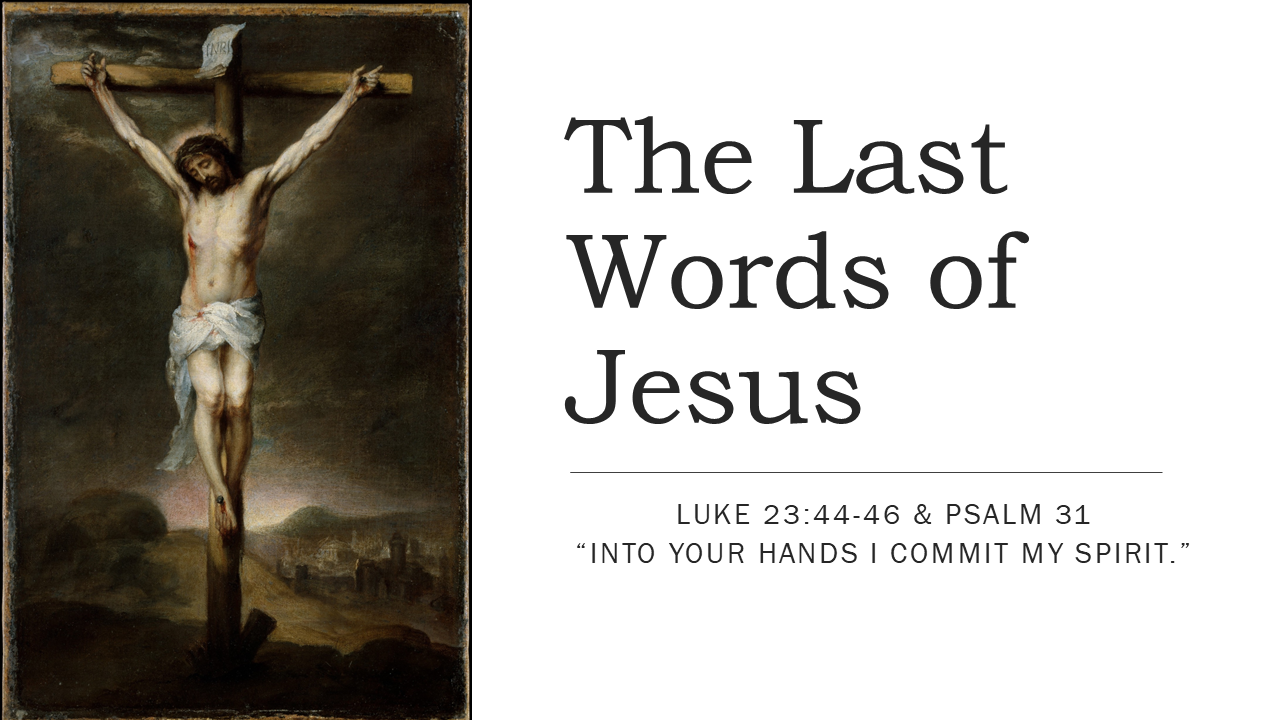
The final statement, the last Jesus said before his death, will be our focus today. We read it earlier, I’ll remind you of it again, Luke 23:46: “Jesus called out with a loud voice, ‘Father, into your hands I commit my spirit.’ When he had said this, he breathed his last.”
I want you to realize that this is not the typical way one dies from crucifixion. Crucifixion was supposed to take longer than this. It was supposed to be a spectacle that lasted overnight and into the next day. It was meant to be a lengthy ordeal that solidified in the minds of everyone in the public square the power and violence of the Roman Empire. There are records of people surviving for upwards of three days on a cross.
It is a shock to everyone—even those Roman soldiers who are experts in execution and death—that it has taken Jesus only six hours to die. In the Gospel of Mark, we’re told that when Joseph of Arimathea went to ask Pilate for Jesus’s body, “Pilate was surprised to hear that he was already dead.”
The twentieth century Bible scholar AW Pink writes:
Voluntarily had the Saviour delivered Himself into the hands of sinners, and now, voluntarily He delivers His spirit into the hands of the Father.
– AW Pink, Seven Sayings
Jesus made a choice to commit his spirit into the hands of his father. His final statement from the cross was a statement of victory. Death had not conquered him. It never once had the upper hand. Not a single time was it ever in control. Christ was not conquered by death, he submitted to it. He stepped into it willingly and offers to us and everyone standing around that cross an important theological truth: Jesus has authority over life and death.
Even in the moment of death, the cross was not a defeat. It was victory. He had been born in Bethlehem so that he might die at Calvary. He had lived a life where every moment, he marched closer to the cross. He controlled the narrative. He was the author of the story. Everything that had happened up until this point was his plan and his purpose.
That final breath is no different. These last words. This final breath. They mean something. They teach us something about who Jesus is and what he proclaims.
The Lamb of God
First, these words teach us that Jesus is the Lamb of God who takes away the sins of the world. That was the declaration of John the Baptist at the beginning of Jesus’s ministry. These final words tell us the purpose of Jesus’s death. If we go backward two thousand years to the Exodus, we learn that God is setting up celebrations—holy days or holidays—for his people to participate in a remembrance of their deliverance.
Now what’s wild about this is that they haven’t been delivered yet. They are still in bondage. But God is about to deliver. And he tells them to take a lamb, slaughter it, and paint its blood on the doorframes of their houses. Then they are to prepare the lamb as a feast, a final meal before their salvation. And for every house with the blood on its door, the judgment of God would pass over them. He tells them they are to celebrate this every year, “A festival to the Lord, a lasting ordinance.” And we’ve come today to call that Passover.
Two thousand years after that first Passover, it is still being celebrated. The city of Jerusalem is filled with Jewish people from all over Israel who have gathered to celebrate this holiest day on the calendar. And in the midst of all of it is a crucifixion. John tells us that Jesus was crucified on the Day of Preparation. All of the things that needed to be done to prepare for Passover happened on this day.
And it’s at the ninth hour, at 3pm, the Passover lambs begin to be slaughtered for sacrifice. The Jewish historian Josephus writes:
So these high priests, upon the coming of that feast which is called the Passover, when they slay their sacrifices, from the ninth hour till the eleventh
And it is at this time, right at that ninth hour, that Jesus Christ calls out these words and commits his spirit to God. The moment Jesus lays down his life is the moment that all the Passover lambs all throughout Jerusalem were being slaughtered. This is intentional. He holds the power over life and death and he willingly gives his life as a sacrifice. He is the Lamb of God who takes away the sins of the world.
But his death is only part of that salvation. After death comes resurrection.
Life After Death
Second, when Jesus says “Into your hands I commit my Spirit,” he is proclaiming that there is life after death. That death is not the end. Those who wanted Jesus put to death would have known that his final words were quoting David in Psalm 31. They would have known it is a psalm of deliverance. They would have known this is a psalm declaring that God will save David from the trouble that he’s in. Not through, not through dying, not spiritually, but physically.
It’s a prayer for God to “be my rock of refuge, a strong fortress to save me.” Verse 8 declares “You have not given me into the hands of the enemy but have set my feet in a spacious place.” And here, those words are being evoked by a man whose feet are nailed to a cross.
To those listening, that Jesus says these words and then immediately dies might seem like failure. God has not saved. God has not delivered. The concept of an afterlife wasn’t really a big thing in the days of Jesus. The majority religious party, the Sadducees, did not believe in life after death. Until about 200 years before the time of Jesus, most Jews took it for granted that after you died, you were dead. Concepts of the afterlife were nonexistent or vague.
So when Jesus says “Father into your hands I commit my spirit” he is making a theological statement that death is not the end. From the pulpit of the cross, he is affirming that there is a resurrection of the dead — that there is new life after death — because God is sovereign Lord even over death. And in God’s sovereign Lordship God also loves us and will not let us down, or let us go. Because of God’s Lordship over everything, and because God loves us, our lives are safe in God’s hands—that we are remade into something new, something perfected, something glorified.
Our View of Death
Third, Jesus had not just come to save us through dying, he had been incarnated into human flesh to show us how to live. On the cross, he is our representative, our substitution, our lamb. In the resurrection, he is the firstfruits of a new, eternal life. But the human life that he lived up to the cross is our example. The way he went to his death—with assurance in God to raise him back up, with confidence that death was not an end but a beginning—that is the way we are to live and die in the here and now.
Peter writes this:
To this you were called, because Christ suffered for you, leaving you an example, that you should follow in his steps.
The word for example is hupo-grammos. Literally, under-writing. It describes the way in which children learned how to write. They would have a clay tablet with letters grooved into them and the students would take the quill and a parchment and use the grooves to practice their strokes. Peter is saying that Jesus is the template for our lives. Jesus even said we should follow him to the cross. We are to imitate him in life. So too we should imitate him in our deaths. Jesus teaches us how to die.
And this can be a difficult thing to talk about. We don’t know how far any of us are from death. But this isn’t really about the moment of death, but in the perspective we take in our lives about death. And death will come. The end will come. Tomorrow or a year from now or if hoping to get at least fifty more. But this is about how, in life, we approach death.
We can have peace and contentment in our final moments because we know what awaits us on the other side. We can have confidence going into death because Jesus is the firstfruits of the Resurrection. He defeated death, so now death becomes a rite of passage, a passing from one stage of existence to the next, a deliverance of our bodies from the hands of man into the hands of God. In our death, whenever it may be, we say “Father into your hands I commit my spirit” and allow God to take us, resurrect us, recreate us, make us new.
And yet, that’s not often our view. Death, we feel, is something to fight against to the bitter end. We have botox injections and face creams and lotions and spend billions of dollars in an effort to look younger and billions and billions more in an effort to live longer.
Dylan Thomas, in his most famous poem, epitomized the human fight against death:
Do not go gentle into that good night,
Old age should burn and rave at close of day;
Rage, rage against the dying of the light.
And if death is the end, if there is no more after, then sure. But if death is the beginning of a new thing, then why? We should not fight death. We should live our lives the fullest and longest that God gives us—we don’t purposely harm ourselves or seek out death—but we need not fear it, we need not hide from it.
I want to share with you a bit about my grandmother’s passing. She was in her 90s and had been given a terminal diagnosis. Doctors said we can fight it, but it won’t solve the problem. Your life will be longer but its quality will not be great. Rage, rage against the dying of the light.
But she knew of a brighter light. My time is here. Let it come. I remember the phone call, I answered it and she said “I’m going to die soon. Let’s plan the funeral.” We planned the funeral. She organized her finances. She said her last words to each of her loved ones. And then she died. In her bed. Peacefully. Not afraid. With nothing left undone. Into God’s loving, tender hands she committed her spirit.
Handing Our Lives
Lastly, we move backward again to our lives here today. Christ is not just our example of how to die, but how to live. Jesus had always been in the hands of the Father—even when he was in the hands of men. His handing over his life is symbolic of something he had always done.
Those last words of Jesus are quoting Psalm 31. The religious elite who wanted Jesus dead would have known these words.
Into your hands I commit my spirit;
deliver me, Lord, my faithful God.
The verse he’s quoting is better rendered as “Into your hand I entrust my life.”
Jesus didn’t only place His life and being in the hands of God at death. He did it in His life. Let’s do the same thing. Let’s affirm not only at death, but in our lives, that we belong to God. Into God’s hands let us entrust our spirits, right here and right now.
Benediction
May we go into the world trusting ourselves to the hands of our loving Father, for He is our rock and our refuge, our strength in times of trouble and our shelter in every storm.
Father, when the path before us is uncertain, teach us to trust in your faithfulness. When our hearts are heavy, remind us that our times are in your hands. When we face suffering, fear, or even death itself, may we find peace in your presence.
And may the final words of Jesus become our daily prayer: “Father, into your hands I commit my spirit.” May we live with open hands, surrendering our fears, entrusting God with our future, and resting in the steadfast love that will never let us go.
Go in peace, knowing that you belong to God, in life and in death, now and forevermore. Amen.