
Summary
This sermon explores the life and ministry of the prophet Amos as a model of courageous faithfulness. Though an unlikely prophet without formal religious credentials, Amos answered God’s call, confronted the injustices of his own community, used his position to advocate for those suffering oppression, and remained faithful even when his message was rejected. Ultimately, his story reminds us that God does not measure success by visible results, popularity, or influence, but by our willingness to faithfully obey the calling placed before us.
Outline
- Amos and the Unexpected IndictmentIsrael celebrates God’s judgment against its enemies until Amos reveals that the same standard of justice applies to them.
- Amos the Unlikely ProphetGod calls an ordinary shepherd and landowner, demonstrating that God does not simply call the qualified but equips those whom God calls.
- Amos the InsiderAmos courageously confronts the sins and injustices of his own people, refusing to protect his in-group from honest criticism.
- Amos the OutsiderThough personally unaffected by much of Israel’s oppression, Amos uses his privilege and position to speak for those whose voices have been silenced.
- Amos and Faithfulness Without ResultsRejected and apparently unsuccessful by conventional standards, Amos reminds us that our responsibility is faithfulness and obedience, while the results belong to God.
Topics
Read the full sermon text
Good morning. First of all, I want to thank Pastor Combridge for having me here this morning. My name is Josh and I met Andrew a while back when he was giving away some books on Facebook Marketplace. We got to talking and he learned that I had been a pastor and was looking for work as a pastor and he was gracious enough to invite me here to share with you this week. It’s an honor that I do not take lightly. I am very grateful to be able share what the Spirit has laid on my heart for you all.
Just to tell you a little bit about myself, you can probably tell from the accent that I’m not from around here. I grew up in the US, graduated from a Baptist seminary, and spent nearly a decade out of seminary as a teaching pastor at a Chinese-American church in Oklahoma. My family and I then moved to England for four years for my wife’s job, where I took a ministry sabbatical—and by that I mean I completed a doctorate in church leadership and served as a lay pastor in a parachurch organization. We then moved to Australia, to Armstrong Creek, about a year ago—again for my wife’s job—and intend to make it our permanent home. We love the people, the community, the culture. It’s been absolutely incredible and when we have tea afterward I’ll share with you so many stories.
Andrew told me that he had been preaching through a series on great figures of the faith. Heroes. Men and women whose lives and stories can inspire us and encourage us in our faith today. These are the folks that we think of as taking up the bulk of the Bible. Moses. Abraham. David. These larger than life figures with larger than life faith—and, if we’re to be honest, larger than life failures.
The person I want to talk about today is someone you probably haven’t thought of in a while. They aren’t listed in the great Hebrews 11 hall of faith. There are very few Sunday School stories about them. They are one of the minor prophets—called such because their prophetic messages are shorter than the major prophets of Isaiah, Jeremiah, and Ezekiel. I want to talk to you today about my favorite hero of the faith: the prophet Amos.
Amos lived about seven hundred years before Jesus and about three hundred years after David. You might remember that after David there was Solomon and after Solomon the nation of Israel split into two—Israel in the north and Judah in the south. Amos was from Tekoa—a military town about 20 kilometers south of Jerusalem in Judah. And he’s called to preach to the people in the northern kingdom of Israel in the temple city of Bethel.
Now this is a time of prosperity for Israel and Judah. They’ve weathered the bad times with the breakup of the kingdom and they’ve now established themselves as separate entities and returned to a time of relative peace and prosperity. In Second Kings, we are told that the king Jeroboam “restored the boundaries of Israel from Lebo Hamath to the Dead Sea.” All the territory that had been lost to foreign enemies was reclaimed and the nation was wealthy and well-respected once again.
Everything seems to be going right in Israel. And then here comes Amos, a wandering prophet from Judah, and honestly the first thing he says has to make Israel feel pretty good. He launches into a series of judgments against Israel’s neighbors. Damascus. Gaza. Tyre. Edom. Ammon. Moab.
Look at this on a map. Amos is one by one calling out the surrounding nation states and proclaiming that the God of Israel will destroy them because of their sins. And the listeners in Israel are getting more and more excited. And this enemy will be destroyed. And that enemy will be destroyed. You can imagine the call and response. The people are shouting back their amens and hallelujahs and a “preach it!”
And then the seventh. Judah. RB Chisholm writes that Israel:
“must have listened with delight to this series of messages, especially when their long-time rival Judah appeared, like a capstone, as the seventh nation in the list.”
Seven is the number of completion in Hebrew thought and symbolism. God created the world in seven days, therefore seven was representative of a completed whole. To the Israelites, it seems as if God has built up all of these convictions against the nations and now completes it with this indictment of their sister nation, Judah.
This is the word of the Lord. The Lion has roared! His judgment shall be just upon the earth. May he rule and reign. And may all Israel be glorify—
This is what the Lord says:
No no. Amos, you’re done, thank you. Nice message, pastor. Haha. Preachers, they never know when to stop talking.
“For three sins of Israel,
even for four, I will not relent.
No. No, no, no. Seven. Completion. Done. You’ve indicted our enemies, thank you. Now move along. Thanks for visiting.
But Amos has laid a trap. Israel was given the covenant with God in order to transform the nations around them. They were meant to be a light in the darkness, a city on the hill. They were meant to be positive influences to the surrounding nations. And Amos says look at all these things the other nations do. Not only have you not been a positive influence—you yourselves engage in every single one of these sins.
And the rest of the book is an indictment against the wealthy and prosperous nation of Israel. I want to share with you three lessons that I have learned personally from Amos’s life and his ministry. I won’t presume to know how those lessons apply to your life, but I know that they do as well.
Amos the Unlikely Prophet
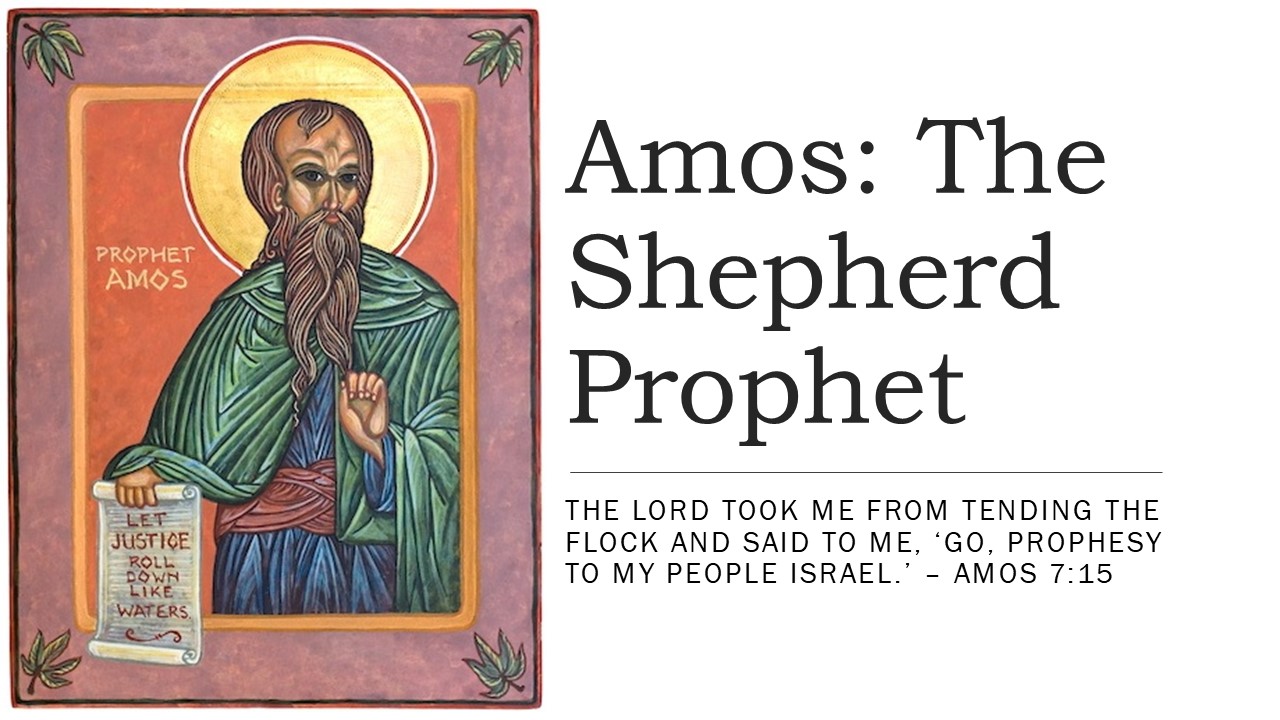
Amos is an unlikely prophet. He’s not a professional preacher or priest. He didn’t attend seminary, had no formal religious training, and freely tells Amaziah that he never sought out the position that he was put in.
Amos answered Amaziah, “I was neither a prophet nor the son of a prophet, but I was a shepherd, and I also took care of sycamore-fig trees.
The phrase “son of the prophet” there likely has more to do with spiritual lineage than physical. He’s saying that he has no formal training. He’s not like the priests; he’s never been to rabbinical school. He’s not like Elisha, who trained under Elijah.
Amos doesn’t have this lineage to fall back on. There is nothing in Amos’s heritage that makes anyone expect that he would rise to this position as prophet. There’s nothing in Amos’s education that makes anyone expect they should take him seriously as a prophet. He’s just an ordinary guy.
The only reason he’s doing what he’s doing is because it’s what God has called him to do. And there’s our first point from Amos’s life.
God does not call the qualified. He qualifies the called. Education didn’t matter. Social standing didn’t matter. Heritage and lineage did not matter. What mattered was simply this: God had given him a message to bear to the people of Israel, so he was going to do that.
A lot of times, in the church, we want to leave the work of ministry to the professionals. In some churches, there seems to be the attitude that the pastor is paid to do the ministry the church won’t. At a previous church, I had a person in my congregation come to me and ask me to go door-to-door in her neighborhood to invite folks to church. I said “I would love to do that with you. When are you available?” And they got this—in America we’d call it a deer in a headlights look. Maybe it’s a kangaroo in the headlights here in Oz. Just wide-eyed, frozen, didn’t expect what was coming. And they stuttered and was like “Well…I…I thought I would just pray about it and you do it.”
I told her, “You know, you said God has laid this on your heart. I think if God is telling you about this, you should be the one to do it. I’ll join you. I’ll be there for you. I’ll pastor you through it.”
Sometimes we get this calling from the Lord and it feels too big or too important or we feel too unqualified. But when the shepherd Amos go this calling to be a prophet, he didn’t hand it off to his pastor. He didn’t go find a rabbi. God gave him the message and he took responsibility for it. He was up to the task because God had given that task to him. He writes:
The lion has roared! Who wouldn’t be afraid? The Lord God has spoken, and I must prophesy his message.
I believe that, for all of us, like Amos, there is some thing, some issue, some way in which the Lion of Judah is roaring in our lives. There is some message that God has spoken to us, some audience that God has granted to us—and it’s ours personally. Nobody else can do that work.
God has a calling for you. Not for me. Not for Andrew. Not for your husband or your wife. Not for your son or your daughter. Not for your neighbor or your church or your government. It’s for you.
And it’s your responsibility. It may not always fit in nicely with your established plans in life. It may take you outside your comfort zone. It may put you in contexts or situations you never thought you’d be in. But if it’s where God has called you, you have to go. That’s the first lesson I’ve learned from Amos.
Amos did not meet the criteria of a preacher or a prophet, at least not the world’s eyes. But to God, the only thing necessary was that he had given Amos a message. The unlikely prophet was the only one speaking truth.
Amos the Insider
The second lesson is that Amos was willing to call out his own in-group. The first thing that we read about Amos is that he is a shepherd. It’s there in the very first verse: “The words of Amos, one of the shepherds of Tekoa.” Later, in chapter 7, he tells the priest Amaziah “I was a shepherd, and I also took care of sycamore-fig trees.” Now initially, we might picture Amos as being rather blue collar. He’s a farmer. He’s a tradie. He works with his hands. Maybe he’s poor. Maybe not academically educated. Definitely not one of the elite.
But when Amos calls himself a shepherd, the Hebrew word he uses is not the same as the typical word for shepherd. He calls himself a nokade—a word used not for the shepherd but the sheep-owner. The only other place this term is used in Scripture is in reference to the king of Moab being a sheepmaster who gives Israel 200,000 sheep. Truthfully, Amos is probably pretty well-off.
When Amos indicted Israel’s wealthy and when he indicted Judah’s religious, he included himself among that group. Amos might not have been guilty as an individual, but he recognized that he was part of a system and part of a nation and part of a covenantal people that was deeply entrenched in sin. So even though he’s not from Bethel, not from Israel—he shares with them as a beneficiary of the current prosperity.
When Amos gave his prophecy, he was preaching to people who looked like him, talked like him, were of the same culture and covenant as him, held the same socio-economic status as him. In other words: Amos prophesies against his own in-group, his own people.
What Amos demonstrates for us is the value of having people within an organization, or a nation, or a denomination, or a church, who are willing to give honest and crucial critiques of their own. All too often, the prophets of the age will willingly prophesy against the nations—they’ll go after the people groups or belief systems they don’t like, the one they are not a part of—but will refuse to call out their own.
We do this in virtually every area of life. We are naturally biased to protect our own. We do it in sport. Their guy plays dirty but our guy is just a really physical player. We do it in politics. The opposition’s guy is a liar. Our guy just knows how to spin a story. We do it in religion. Our sins are our struggle and we are so thankful for God’s grace. Their sins blatantly disregard God’s word and are unforgiveable.
In the Sermon on the Mount, Jesus says we criticize the other for the speck of sawdust in their eye all the while we have a whole timber sticking out of our own eye.
We have this tendency of looking around at others, criticizing them for their own faults and shortcoming, but not holding ourselves to that same standard.
The lesson from Amos is that we must be willing to honestly evaluate our own “group” and call out injustice where we see it. When Amos hears the word of the Lord about the injustice that people like him are committing, he doesn’t try to excuse it or justify it or downplay it. He calls it out. Even if it is unpopular, even if it stands against the status quo, even if it threatens our status as an insider—which is exactly what happened to Amos.
Amos the Outsider
As much as Amos is like the people to whom he is sent, he is also separate from them. He has some of the privileges and commonalities with the in-group but he’s also an outsider. The problems of Israel don’t have to bother him.
Amos isn’t being persecuted by Israel. He has no personal problems with the city of Bethel. But God has made him aware of what’s going on in Israel. He knows that
They sell the innocent for silver,
and the needy for a pair of sandals.
He knows
They trample on the heads of the poor
as on the dust of the ground
and deny justice to the oppressed.
Because of his wealth, because of where he lives, because of who he is, he’s not affected by Israel’s sin. But he is willing to give a voice to those oppressed groups, willing to take up the cause of those who were not like him.
He didn’t look at the oppression of the poor in Israel and say “at least I’m not one of them.”
He didn’t consider the many thousands of individuals sold into debt slavery and think “There but by the grace of God go I.”
He didn’t hide himself away from the evil that surrounded Tekoa instead he marched into the halls of power in Bethel and confronted it.
This is why Amos is a hero of the faith. He uses the position and the privilege he has to speak up for those whose voices have been silenced. It is very difficult for the voices of the oppressed to be heard. What these oppressed poor needed was an outsider. They needed someone outside of their group, outside of their oppression, to empathize with them, to enter into their suffering, and to be that voice to power that they could not be.
Amos came to understand that justice will only come when those unaffected by injustice are as outraged by it is as those who are. Silence in the midst of injustice is to be part of that injustice.
Amos’s ministry encourages us to get out of our safe zones, to be willing to put down our privileges and take up the mantle of the oppressed, to give a voice to the voiceless, to speak truth to power, to enter into unfamiliar contexts, and to follow the calling of God even when his calling takes us to unexpected places.
The Seemingly Silenced Prophet
Just because you speak up doesn’t mean folks will listen. Just because God lays a message on your heart does not mean that revival will immediately follow. We obey and we trust God for the results. As he preached in Israel, I don’t know if he expected revival. Maybe he did. But what he soon discovered instead was that speaking truth to power will often get one silenced.
In Amos 7, Amaziah, the high priest at Bethel, confronts Amos:
“Get out, you seer! Go back to the land of Judah. Earn your bread there and do your prophesying there. 13 Don’t prophesy anymore at Bethel, because this is the king’s sanctuary and the temple of the kingdom.”
Just because you speak up doesn’t mean people will listen.
Just because God gives you a message doesn’t mean that message will be popular. And just because you are faithful doesn’t mean you will get to see the results of your faithfulness.
Amos preached—and then Amaziah told him to go home.
And after that, we don’t really hear from Amos again. After this proclamation from Amaziah in chapter 7, Amos responds with series of prophecies in chapters 8 and 9 and then the book ends. Amaziah tells Amos to go home and, for all we know Amos did just that.
There is no record here that Amos’s preaching changed anyone’s mind. We’re not told of one disciple or one convert. By modern church growth standards, Amos is a bit of a failure. But by God’s standards, Amos is an overwhelming success.
God doesn’t measure the efficacy of Amos’s faithfulness by the size of the response. Israel doesn’t change. They don’t heed Amos’s warnings. For all it cost Amos, it’s not at all apparent that his words did anything.
So here’s the final lesson: God doesn’t judge us by results, but by faithfulness. We are to follow God and trust God for the results. Amos heard the lion roar. And he obeyed.
Maybe you’ve spent much of your life thinking that your most important work for God is behind you. You’ve raised your children. You’ve worked your jobs. You’ve served your church. You’ve cooked meals and visited the sick and sat beside hospital beds and prayed with people in difficult moments. You’ve lived your faith publicly, yet it seems like churches are getting smaller. Christian influence is decreasing. And you might be wondering if your ministry mattered.
I want to tell you: You’re not too insignificant for your faithfulness to matter.
Amos wasn’t a professional prophet. He wasn’t looking for a platform. He wasn’t trying to build a ministry. He was simply going about his life when God gave him something to say.
And when the lion roared, Amos listened.
Were is God asking us to be faithful?
The world tells us that success means being noticed, effecting immediate obvious change. Amos reminds us that faithfulness means being obedient. The people of Israel didn’t listen to Amos. But those words of his were written down and have been studied for over two thousand years. They were paradigm-shifting in my own life and ministry.
May we be like Amos. May we be willing to speak when God tells us to speak. May we be willing to go when God tells us to go. May we be willing to stand with those whom God sends us. And may we be willing to remain faithful even if we never see the results.
Because our calling is not to change the whole world. Our calling is to be faithful in the place where God has put us. The lion has roared. What else can we do but prophesy?