
Summary
Jesus’ parable traditionally called the Prodigal Son is really a story about a pursuing father and two lost sons, both of whom misunderstand their relationship with him. In this sermon, Dr. Josh Olds explains how the younger son believes he must earn his way back after wasting his inheritance, while the older son believes his faithful service has made him deserving of greater reward, but the father offers both sons the same thing: not servanthood, but sonship. Through the image of a father who willingly sacrifices wealth, dignity, and status to restore his children, Jesus reveals a God who runs toward us, repairs the relationship we could never repair ourselves, and joyfully welcomes every lost child home.
Outline
- The Story Is About the Father, Not the ProdigalRather than focusing on the younger son’s wastefulness, Jesus places the father at the center as the one who generously gives, pursues, sacrifices, and restores.
- The Real Problem Is the Broken Relationship, Not the Wasted WealthThe younger son assumes his failure is something he can repay, but Jesus reveals that what truly needs restoration is his relationship with his father.
- God Runs Toward Us When We Turn Toward HimWhile the son is still far away and trying to earn his way back, the father runs to meet him, embracing him before he can complete his rehearsed apology or offer to become a servant.
- God Wants Children, Not ServantsBoth sons understand their relationship with their father in terms of servanthood, but the father rejects both approaches and insists on calling them his sons and welcoming them into his home.
- Everyone Is Invited to the PartyThe story ends with an unanswered invitation to both the rebellious younger son and the resentful older son: will they accept the father’s grace, come home, and join the celebration?
Topics
Read the full sermon text
Last week I left you on a cliffhanger. We were talking about Luke chapter 15 and these three stories that Jesus told when the religious elites confronted him for being friendly to the people they didn’t consider worthy of fellowship. Jesus says “Why am I eating with these people? Let me tell you why. And he tells a story about a searching shepherd, a seeking woman, and a running father.
Last week, we took a look at those first two stories. Each one begins with a significant loss, continues with a desperate search, and concludes with a joyous celebration. The first story was about the loss of one out of a hundred, the second was the loss of one out of ten. Jesus is intensifying the story each time he tells us. This third story is about the loss of two sons.
And here’s where I want to pause a minute and remind you that the typical way these stories are framed, I think, misses the point. This story is traditionally called The Prodigal Son. The fourth century Church Father St. Jerome was the first person to call it this. When he translated the Greek New Testament into Latin, he called this parable “Filius Prodigus”—Filius meaning son and prodigus meaning wasteful. A story about a wasteful son. But that focus on the son causes us to misunderstand some things.
The main character in the story is not the son—prodigal or otherwise. It is the father. Jesus says it quite clearly, no need to consult the commentaries or exegete the Greek:
11 Jesus continued: “There was a man who had two sons.
Think for a minute about Bible stories about two sons. Cain and Abel. Ishmael and Isaac. Esau and Jacob.
12 The younger one said to his father,
Ok, they think they know where this story is going. The younger son is obviously the good guy, right? Abel, Isaac, Jacob.
12 The younger one said to his father, ‘Father, give me my share of the estate.’
And this is scandalous behavior. He wants his inheritance. He wants his share of the estate before his father dies. He hasn’t earned it. He doesn’t deserve it. And moreover, his father is still alive and in good health. Jesus’s listeners are enjoying the twist to the story. They are ready for the father to act like they would have acted if they were the father. The son is in trouble now.
So he divided his property between them.
Up to this point, Jesus’s storytelling has been typical and understandable. Will a shepherd search for his lost sheep? Yes, absolutely. Will a woman search for her lost coin? Yes, absolutely. Will a father give his dumb, insolent kid an advance on his inheritance? Absolutely not.
And yet. He divided his property between them. Not just the younger son, but the older son as well. The father does something incredibly dumb by his community’s standards. He gives generously to his son. Not just his money, but his support. He opens himself up to ridicule within his community. He absorbs the dishonor of the request. He gives generously and willingly to his sons. Jesus now puts himself in the position of the Father in the story. Eating with tax collectors and sinners—showing this lavish generosity and grace—is opening himself up to ridicule. But he thinks it is worth it.
This younger son now has all the wealth and power and prestige of the father. He has been blessed beyond measure even though he doesn’t deserve it. This was a sizable inheritance. The younger son should have been set for life. It’s like hitting the lottery. This is enough money that he can do whatever he wants with it. Success should be easy because he has been so blessed by his father. If he wants to start his own business, he has the money to do that. If he just wants to live off investments, he can do that.
What does he do?
13 “Not long after that, the younger son got together all he had, set off for a distant country and there squandered his wealth in wild living.
He had all this potential and he blew it in a single verse. This is where that term prodigal son comes from. He was given all of this wealth to be a blessing, instead he made it about himself. He wasted it. He lived in luxury. He wore the finest clothes. He ate the best food. He hosted the best parties. He splurged on a two-hump camel. He spared no expense.
Millions of dollars went to thousands went to desperate pleas for the creditors to lend more led to him begging for a job feeding slop to pigs. He learned the lesson that when your outgo exceeds your income, your upkeep becomes your downfall.
It’s frustrating to read. Because if I had been given that money, I would have done something with it. I would have invested properly. I would have used it to help people. I would have started a successful business. I wouldn’t have lost it all. If I had been the younger son, I would not have been so wasteful. I would have taken care of my father’s money. I would not have been a prodigal.
Our focus—living in a very wealthy, very materialistic culture—is on the wastefulness, the loss of wealth. The younger son’s problem was that he lost his dad’s money. And this is what the son thinks the problem is too. When he decides to go back to his father, he says:
I will set out and go back to my father and say to him: Father, I have sinned against heaven and against you. 19 I am no longer worthy to be called your son; make me like one of your hired servants.’
He thinks that the problem is the money. We think that the problem is the money. But does Jesus think the problem is the money? Is this true? What if the son had left with all of his inheritance and been successful? What if he had built a multi-billion dollar company out of it? What if he had used the money wisely and become even wealthier than his father?
In the younger son stories, that’s kind of what happens. Think of Jacob, who also runs away from home. Now he doesn’t have his father’s wealth to start with but he makes something of himself despite his uncle Laban doing all that he can to tear him down. You read the book of Genesis and Jacob is sort of an anti-Prodigal Son and I think Jesus is very subtly referencing that here.
We praise success stories like that. Look at how good his investments are! He started his business with nothing and now look at how it’s grown! He’s a self-made millionaire. And the younger son has it on easy mode. He already has the money! If the younger son had been successful, as we would naturally expect, we would not think so poorly of him.
But if the younger son had become wealthy and successful, he would be a young, wealthy, successful businessman with a terribly broken relationship with his father. The problem isn’t the money. The problem is the broken relationship.
Wealth can often mask brokenness. That’s why Jesus says at another time:
Truly I tell you, it is hard for someone who is rich to enter the kingdom of heaven. 24 Again I tell you, it is easier for a camel to go through the eye of a needle than for someone who is rich to enter the kingdom of God.” (Matt. 19:23-24)
If the younger son had been successful, his relationship with his father would have remained broken. The problem isn’t that he’s a prodigal. The problem is that he’s not in a right relationship with his father. But the son doesn’t realize that yet. He still thinks it’s about money.
17 “When he came to himself, he said, ‘How many of my father’s hired servants have food to spare, and here I am starving to death! 18 I will set out and go back to my father and say to him: Father, I have sinned against heaven and against you. 19 I am no longer worthy to be called your son; make me like one of your hired servants.’ 20 So he got up and went to his father.
He gets up to go to his father, but he hasn’t seriously repented. He doesn’t even understand what he needs to repent work. He’s just trying to work himself back into the good graces of his father. He’ll become a hired servant, pay his dad back, and then maybe he can be part of the family again.
And this is patently ridiculous. There is no way on the wage of a hired servant he can repay what he has lost. How many of us approach God the same way? How many of us, when we are far from God, when we are in our own pig sty, attempt to run back to God by relying on ourselves? By believing that we can pay for our own atonement?
But he’s not sincere. He’s not genuine. His ah-ha moment isn’t that he needs to repent. It isn’t that he needs to fix the relationship with his father. It’s “I know, I’ll go to daddy and sound religious.”
We know he’s not sincere because of the language he uses: “I have sinned against heaven and against you.” Jesus’s listeners, especially the religious elite, know this phrase. They read it every Passover. This is exactly what Pharaoh says just after the plague of locusts has destroyed the Egyptian crops:
Pharaoh quickly summoned Moses and Aaron and said, “I have sinned against the Lord your God and against you.
From this wording, they knew that the apology is insincere. And they know what happened to Pharaoh. They know that he hardens his heart. So they’re waiting to see how the Father handles this.
All the way home, the younger son practices this phrase: Sinned against heaven and you, not worthy to be called a son, make me a hired servant. He wants the relationship between him and his father to change. I’m no longer your child, make me a servant.
Then something odd happens. Now we come to the beautiful part of the story. Jesus shifts perspectives. He says that the Father has been watching and listening.
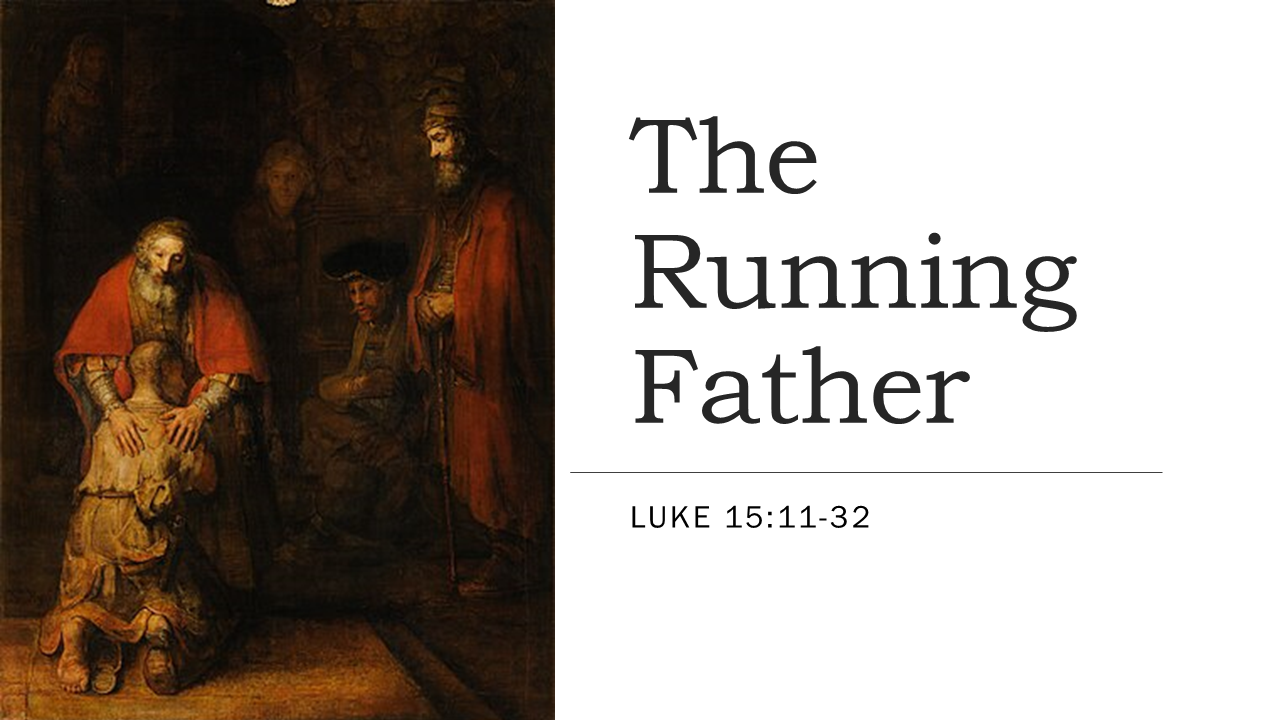
But while he was still a long way off, his father saw him and was filled with compassion for him; he ran to his son, threw his arms around him and kissed him.
This is what our main character does. He cannot force his son to return. But he will pray and he will watch and he will wait. Jesus doesn’t tell us how many years the prodigal was away. One? Five? Ten? Twenty? How long had the father been waiting to see his son again? Maybe, and I’m imagining here, okay, the son goes off on wild living in a neighboring country.
And maybe occasionally the father gets news. A traveler comes in from that country. The Father finds him “Do you know anything about my son?” And he hears stories no father wants to hear about his son squandering his money. But at least he’s safe. And then famine hits. Money dries up. No more news. Dad doesn’t even know if the son’s alive.
Yet here he is, while the son is a long way off, running toward him. How did the father know this was his son? Maybe he just saw a figure that looked like it might be, could be, and so he ran? How many times had the father made this run before, only to be disappointed?
Every time a stranger visits town, out comes the village crazy man to see if it’s his long-lost son. The father not only sacrifices his wealth for his son; he also sacrifices his dignity. He’s gone from pillar of the community to having the pity of the community.
Sometimes is coming into town again and off he goes, hoping against hope that it is his son. And he runs. He runs. The old man runs. He girds his loins, tying up his robes, and goes down the road to the figure in the distance.
Jesus is telling a story about a pursuing God who would risk being dishonored and looking undignified in order to bring lost ones into his kingdom. Not too long after telling this story, he would himself hang naked from a cross.
There is the focus. There is the central figure in his story, in all of history. Not the lost son, but the running father.
The father still runs today. He is a God who pursues. A God who will go to the uttermost to bring just one more person into his kingdom, into his family. This is not a story about us. This is not a story about financial failure. This is a story about a God who takes broken relationships and makes them whole.
Every world religion, in some way, is about man reaching up to God. Do enough good things and you will get into heaven. Say the right mantras and salvation awaits you. It all stems from the ancient Tower of Babel where they tried to build a pyramid to reach the heavens.
And we couldn’t do it. We couldn’t reach God. How could we? He is infinite and completely beyond us. We could not reach up to him. So he reached down to us. He ran our direction. He pursued us into time and space and flesh and bone all the way to a cross.
Jesus didn’t come to give us new information about God, even though knowing him is the greatest knowledge you’ll ever receive. He didn’t come to tell us to believe new things, even though believing in him is the greatest choice you’ll ever make. He didn’t come to tell us new things to do for God, even though serving him is the greatest work you’ll ever accomplish.
He came as God himself to sacrifice himself for us to repair the relationship that we could not fix, to bring us back into his family. What separates us from God is not our sins or our failures. All of those things have been taken away by Jesus. He covers and atones for our sin. What separates us from God is that the relationship has been broken.
We should not ask to be a servant. He has called us his children, his daughters, his sons. And the so-called prodigal at the feet of the father is about to learn this.
“The son said to him, ‘Father, I have sinned against heaven and against you. I am no longer worthy to be called your son.’
Stop. That’s it. No discussion of being a servant. Because the father interrupts him. There is no talk about being made a servant, because the father says:
‘Quick! Bring the best robe and put it on him. Put a ring on his finger and sandals on his feet. 23 Bring the fattened calf and kill it. Let’s have a feast and celebrate. 24 For this son of mine was dead and is alive again; he was lost and is found.’
This son of mine. Son. The problem was never the money, it was always the broken relationship. The relationship that was broken even before the son received the money, even when the son was still at home with the father. If the relationship had not been broken, the son would not have demanded his inheritance.
The father considers the lost wealth a worthy price to pay for the redemption of his son. He will accept the loss because it means regaining his son. He will pay it all. That’s the Gospel picture here, that’s the perspective that the Bible is trying to show us.
That God will give up everything in order to bring you back into his home. That God will sacrifice greatly so that you can live eternally with him. That regardless of what you have done to offend him, when you come walking toward God, he will come running toward you.
He will put a ring on your finger, a cloak on your back. He’ll kill the fatted calf and prepare a celebration because his son, his daughter, his child who was lost is now home.
But hold on. There are two sons. Just when it seems like everything is headed to a happy ending, we remember the older son. That son also got his inheritance. This has been the faithful son. And this son is angry.
Look at verse 29:
But he answered his father, ‘Look! All these years I’ve been slaving for you and never disobeyed your orders. Yet you never gave me even a young goat so I could celebrate with my friends.30 But when this son of yours who has squandered your property with prostitutes comes home, you kill the fattened calf for him!’
He can’t even call the younger son his brother, instead saying “This son of yours.” Earlier, the father has said “this son of mine” in love; now the older son says it in hate. The older son implies he has served his father as a slave and “you never even gave me a young goat.”
But remember the beginning of the story? The older son got his inheritance too! And, as the older son, it would have been twice what the younger son received. This isn’t the story of the prodigal son, it’s the story of two lost sons and father who calls them home.
One has always claimed to be close to the Father, while the other ran away and went afar off. The father explains himself, ending with the implicit offer to come, eat, join the celebration. But it’s here the story stops. Jesus simply ends it without any conclusion. What happened to the older son?
Think about how Jesus told stories. How did this chapter first begin? He was eating with tax collectors and sinners when stopped by the religious elite. And now Jesus turns to the Jewish leaders, those standing at the door of his party. And his question is obvious:
You’ve always said you were close to me. Won’t you come in and celebrate with us? Won’t you come home as well? Won’t you mend this broken relationship you have with me? Won’t you come and sit at this table of the repentant?
Younger son or older son, sheep or coin, Jesus invites all of us to the party, he invites all of us in to accept his grace. Shall we, like the older son, stand outside? Or shall we, like the younger son, succumb to relentless pursuit of God’s love?
Read the text. Both the younger son and the older related to the father in the same way. The younger son says “I am not worthy to be called son, I will ask to be a hired servant.” The older son says “All these years I have been your slave.” They see their relationship as master-servant. But the father doesn’t want that. He wants to relate to them as sons.
There are no hired servants at God’s table. Only children. And that is the gospel. That while you were afar off, God came running. That before you ever thought of repenting, God forgave you. That while you were yet enemies of God, he died for you. And that now, he brings you in, puts a ring on your finger, a robe on your back, and celebrates, because the son or daughter that was lost is now found. His question to the religious elite is the question he asks of us today: Will you come and join the party?