
Summary
Jesus’ parables of the lost sheep and lost coin reveal a God who relentlessly pursues those who are lost, values those whom others consider worthless, and celebrates when they are found. Rather than focusing primarily on the failure or lostness of the sheep and coin, Jesus draws attention to the searching shepherd and sweeping woman, showing that God’s character is defined by pursuit, love, and restoration. The message challenges the church to see people not as “those people” to be judged or avoided, but as people of immense worth whom God is actively seeking and welcoming into the community.
Outline
- God Is a God Who Pursues the LostLike the shepherd who leaves the ninety-nine to search for one lost sheep, God relentlessly pursues those who have wandered away and works to restore them to relationship.
- God Pursues Those the Religious Community Has Cast AsideJesus challenges the religious leaders by showing that the people they reject and exclude are precisely the people God is seeking and welcoming.
- God Values Those the World Considers WorthlessLike the woman who carefully searches for one lost coin, God considers every person deeply valuable regardless of their social standing, failures, or perceived shortcomings.
- God Is Willing to Get Messy to Find UsThe searching shepherd and sweeping woman reveal a God who is not afraid to enter the mess of human life, searching every corner and refusing to give up on those who are lost.
- God Celebrates When the Lost Are FoundGod does not reluctantly accept the restored or simply check them off a list, but joyfully celebrates every person who is found, restored, and welcomed into God’s kingdom community.
Topics
Read the full sermon text
First of all, thank you so much for having me back to join with you in worship today. My prayers are with Andrew and his family as they make their way across the ocean. It’s a long trip. I’ve only made it once with two young children, so maybe it’s easier without little kids. I pray it is a restful, restorative time for them.
I don’t know about you, but I love to read. You might remember that I met Andrew because he was giving away books, so this may not be a surprise to you. I love to read and I’ve always loved stories. For about fifteen years now, I’ve run a book review website called Life is Story. If you’re interested you can visit lifeisstory.com and we review Christian fiction and non-fiction.
Over the years, I have had the opportunity to talk a with a number of Christian authors and interview them. Jerry Jenkins, Francine Rivers, I don’t really how many of these folks are well-known in Australia—but if you want some fiction recommendations, talk to me after the service. Before I moved here, I was judge in the Evangelical Christian Publisher Association’s annual book awards. I actually met my wife on a Christian fiction Internet forum. I love stories and in return stories have returned the favor and loved me.
This is part of why I love the way that Jesus teaches. He uses stories to get his point across. He takes these great big theological concepts and presents them to his audience in language and descriptions they could easily understand. Jesus wasn’t talking high-minded philosophy with the educated. He was talking to the average person, the everyday man or woman, and so he spoke in language and experiences that spoke to them.
And I’m getting off on a tangent already, but this is what the Incarnation is. It is God writing himself into his own story, presenting himself to us in a way we could comprehend. God is infinite, all-powerful, incomprehensible—but he makes himself known in Jesus.
John says in his Gospel that “No one has ever seen God, but the one and only Son, who is himself God and is in closest relationship with the Father, has made him known.”
We have come to know God because he entered into his story in Jesus.
The chapter of the Bible we are going to consider over the next two weeks is the pinnacle of Jesus’s storytelling where he tells three interconnected stories all told together, all meant to explain to the religious elite why he was sitting at a table having food and fellowship with those they considered to be sinners.
Now the tax collectors and sinners were all gathering around to hear Jesus. 2 But the Pharisees and the teachers of the law muttered, “This man welcomes sinners and eats with them.”
And Jesus tells them three parables in one. You’re probably already familiar.
The three parables are The Lost Sheep, The Lost Coin, and the Lost Son. That’s the way they are headlined in the Bible. But I want you to notice something at the outset because that’s going to inform the way in which we look at these parables. Are these stories primarily about lostness? Or are they about being found?
Jesus has been asked a question: Why do you eat with sinners? His response: A shepherd lost his sheep, a woman lost her coin, a father lost his son. The focus is not on the lostness but on the what the main character does to retrieve that which was lost.
We love to put ourselves in the place of the main character, and we do rightfully notice that we are the lost things in these parables. But we are not the main character. God is. And these are parables about God’s pursuit of those who are lost.
These are parables about a searching shepherd, a sweeping woman, and—and this is one we will get to next week—a running father.
A lot of times when we consider this chapter and look at these stories, we tend to rush over those first two in our hurry to get to the third one. The Prodigal Son. Maybe the most famous fictional story in the Bible. The most famous of all the parables. But it’s not as if Jesus told the first story and went “ehh…first draft…let me try again.” And then told it a second time and didn’t quite get it right. And then got it right on the third try. Each of these three stories show us a different element of God’s pursuit of God’s people.
The Lost Sheep
In response to these accusations that he entertains sinners, Jesus responds, with a story:
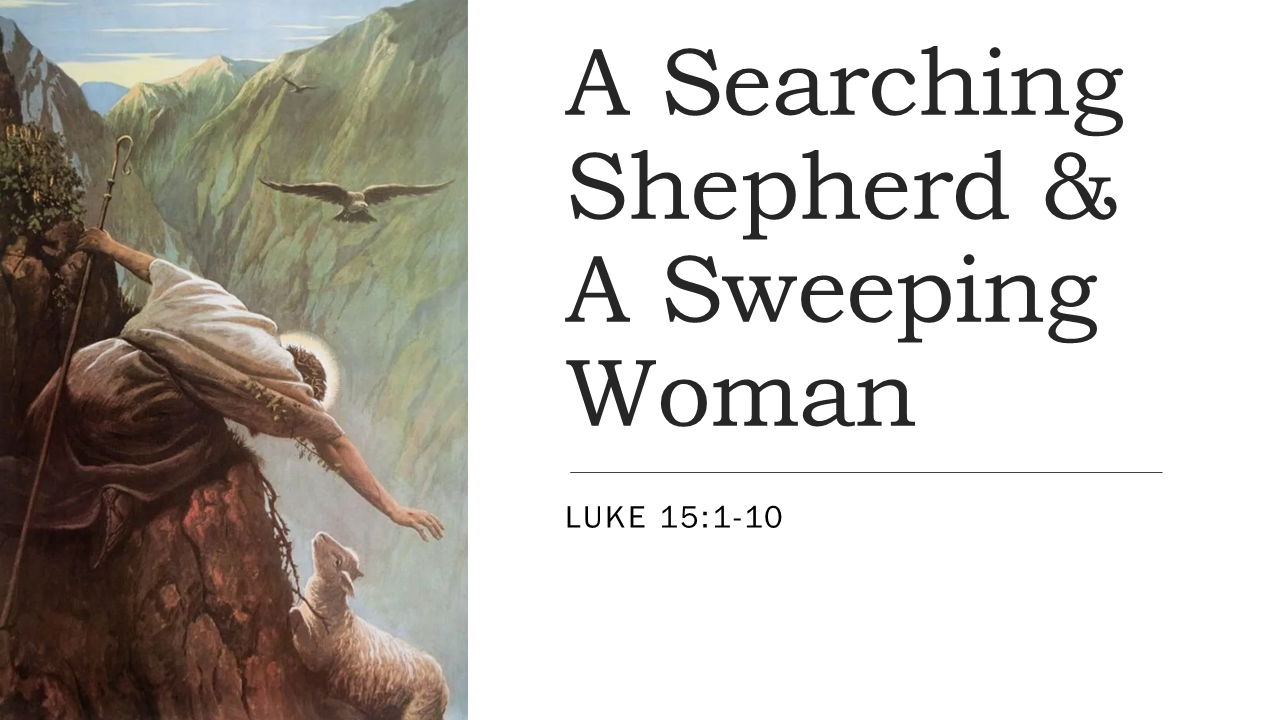
4 “Suppose one of you has a hundred sheep and loses one of them. Doesn’t he leave the ninety-nine in the open country and go after the lost sheep until he finds it?
In the first century middle east, the “suppose” part of this was a bit easier. Sheep herding was a common job for young boys, even if it wouldn’t be their job as an adult. Everyone was familiar with how sheep were fed and kept.
When Jesus invites his listeners to strap on the sandals of a shepherd, he isn’t making a difficult mental leap for his audience. This is a story they understand. His question, then, is less of a question and more of an affirmation. There’s an obvious answer.
Of course you leave the 99 in search of the one. No sheep gets left behind. Sheep are herd animals. They cannot survive on their own. Once a sheep is away from the herd, away from the shepherd, there’s no chance that it’ll wander back on its own even if it wants to.
You know the popular nursery rhyme, Little Bo Peep has lost her sheep and doesn’t know where to find them. Terrible shepherding advice.
Leave them alone and they’ll come home and bring their tails behind them. Untrue. Fake news. False. Sheep are not good at directions. Once they have lost sight of the shepherd, once they are separated from the flock, there’s virtually no hope of them finding their way back.
It’s very easy to wander away from a fixed point. I can go any direction and wander away. It doesn’t matter which way I go. But to get back, I have to take a directed path of action. I can’t just go anywhere and get back to where I need to be. There are many paths to lostness. There is only one certain and defined path to the shepherd.
Do you know what that means? Bo Peep’s sheep are dead. She’s sitting at home, waiting for them to come, tails wagging behind them, but it’s not going to happen. You can wander away from the Good Shepherd, but only his pursuing love can bring you back.
And here’s the focus of the story. It’s not on the lostness of the sheep or the things they saw and did, or how scared and anxious they were—and those are valid stories—but this story is about the shepherd who goes off in pursuit of the one lost sheep. The nature of the shepherd as agreed upon by everyone is that shepherds pursue and take care of their sheep.
Jesus is making this point: The nature of the shepherd is to pursue lost sheep. The nature of God is to pursue lost souls. This began all the way back in the Garden. It’s all God ever really wanted. It’s why he created humankind in the first place. For friendship.
But then, in an instant, that relationship is broken by sin, as our first parents wandered away.
As Isaiah wrote in his famous messianic chapter—
We all, like sheep, have gone astray,
each of us has turned to our own way; (Isa 53:6a)
And the chase has been on ever since.
God has been tracking down his lost ones and bringing them into his Kingdom. He has been restoring and redeeming those broken relationships. There are sheep that have been cast out of the flock. There are those whom the Christian community has left out. I’m not going to tell you who they are because it’s different for every Christian community.
I know so many people who have left the community of the church because the church wasn’t community for them. I know so many people whose experience with the church community is one of judgment and damnation rather than love and mercy. People whose interest in God faltered because the church community didn’t seem interested in them.
That’s what’s happening here. That’s why Jesus is eating with sinners. That’s why he had table fellowship with tax collectors. He was right where you would expect God to be: right in the middle of rounding up his lost sheep.
There is a subtle indictment here that the Pharisees and teachers of the law—the religious elite—understand. They consider themselves the shepherds of Israel. They are the leaders, the guides. Jesus is saying “here are your lost sheep. Not only have you not done your job in searching for them—you are the ones responsible for driving them out.
He’s not just referencing a general metaphor. He’s going back to a specific prophecy by Ezekiel. Ezekiel lived about six hundred years before Jesus. His prophecies cover the end of the kingdom of Judah and their carrying away into captivity by Babylon. And it is a time where the religious leaders are a disgrace.
In Ezekiel chapter 8, God shows Ezekiel how the religious leaders are worshipping idols and false gods inside the Temple. Here is the very presence of God in the Ark of the Covenant, in the Holy of Holies, and Ezekiel records that the religious leaders of Israel are instead worshipping false gods.
He said to me, “Son of man, have you seen what the elders of Israel are doing in the darkness, each at the shrine of his own idol? – Ezekiel 8:12a
And because of this, God says to Ezekiel, that presence of God—that glory of God that had rested over the top of the Ark of the Covenant since the days of Moses—was going to leave. That’s exactly what Ezekiel records. The presence of God leaves the Temple and the religious leaders do not notice because they are worshipping their false gods.
You get to Ezekiel chapter 34 and Ezekiel records a chapter-long condemnation:
The word of the Lord came to me: 2 “Son of man, prophesy against the shepherds of Israel; prophesy and say to them: ‘This is what the Sovereign Lord says: Woe to you shepherds of Israel who only take care of yourselves! Should not shepherds take care of the flock? 3 You eat the curds, clothe yourselves with the wool and slaughter the choice animals, but you do not take care of the flock. 4 You have not strengthened the weak or healed the sick or bound up the injured. You have not brought back the strays or searched for the lost. You have ruled them harshly and brutally. 5 So they were scattered because there was no shepherd, and when they were scattered they became food for all the wild animals. 6 My sheep wandered over all the mountains and on every high hill. They were scattered over the whole earth, and no one searched or looked for them.
Then verse 11:
11 “‘For this is what the Sovereign Lord says: I myself will search for my sheep and look after them.
When Jesus presents himself as the Good Shepherd, he’s outright stating that these religious leaders—the ones who pride themselves on how strictly they adhere to God’s word—are no different than their idol worshipping ancestors.
This God-as-Shepherd metaphor is one that is used throughout Scripture. David, the shepherd-boy turned warrior-king, uses the imagery of God as shepherd in his most famous song.
“The Lord is my shepherd, I lack nothing.” (Ps 23:1)
Continue on to the end of his poem in verse 6 and it reads:
Surely your goodness and love will follow me
all the days of my life,
and I will dwell in the house of the LORD
forever.
David is saying here that as we, the sheep, follow God the shepherd, God’s goodness and love follow us. Except that the word “follow” doesn’t really do justice to the term’s strength of meaning.
In Hebrew, the word is yeerd-foo-NEE. Different forms of that word appear about 144 some times in the Old Testament. Ninety-eight of those times—I counted them—it is translated to some form of “pursue.” Thirteen times it gets translated “chase.”
David isn’t saying that God’s goodness and love are just sort of there with him. He’s saying “God relentlessly pursues and chases his lost sheep.”
“Surely your goodness and steadfast love will pursue me relentlessly all the days of my life, and I will dwell in the house of the Lord forever.”
I am reminded of the poet Francis Thompson, who lived in the late 1800s in London. At age 11, he entered university. At age 18, he began medical school. But at age 26, he dropped out, had a nervous breakdown, and soon found himself a homeless drug addict living on the streets of London.
After three years of homelessness and opium addiction, an older couple saw promise in him and took him into their home. During this time, Thompson gave his life to Jesus. He began to write and, in 1893, he published a volume of poetry, which included a piece he called The Hound of Heaven.
I won’t share with you the whole poem, but it’s definitely worth your time. It begins:
I fled Him, down the nights and down the days;
I fled Him, down the arches of the years;
I fled Him, down the labyrinthine ways
Of my own mind; and in the mist of tears
I hid from Him,
And Thompson goes on to portray God as a hunting dog, the hound of heaven tracking him down following him no matter where he went. And he recounts all the things he sought to replace the God he fled but each one leaves him empty and wanting. In the final stanza, Thompson laments that he has wasted his life on fleeing God. He mourns that he has lost everything he wanted. And then, in the poem, comes the voice of God:
All which thy child’s mistake
Fancies as lost, I have stored for thee at home:
Rise, clasp My hand, and come!’
Thompson, like all of us, was pursuing relentlessly into the arms of a loving Father.
Jesus ends this parable of the searching shepherd and says that the shepherd always gets his sheep:
5 And when he finds it, he joyfully puts it on his shoulders 6 and goes home. Then he calls his friends and neighbors together and says, ‘Rejoice with me; I have found my lost sheep.’
That’s his first parable.
A Lost Coin
The second parable is shorter.
Or suppose a woman has ten silver coins and loses one. Doesn’t she light a lamp, sweep the house and search carefully until she finds it?
Suppose, Jesus says. Take off the sandals of a wealthy shepherd for the house slippers of a peasant woman. She has ten coins and she loses one.
Now you might laugh this off. What’s one lost coin? To the Jewish leaders Jesus was speaking to, one lost coin wasn’t something to lose sleep over. They had money to spare. Their treasury was overflowing. This wasn’t a big deal to them.
These ten coins represent the equivalent of ten days’ wages, but to a peasant woman they have a far greater worth. The lower class primarily engaged in bartering. Coin money was a luxury. These ten coins represent the family’s savings, now reduced by a tenth. 10% of their net worth has now vanished. If 1 out of 100 sheep were important, how much more important is this 1 lost coin out of 10!
The value of the coin comes not from its objective monetary value but from the financial security it brings and the amount of work it represents.
And you can almost hear Jesus’s conclusion click in the minds of the Jewish leaders: the things you call worthless, I call worthy.
First, he is a God who pursues those the world says isn’t worth running after. Second, he is a God who values those the world says is of no account. Those the world rejects are those the God of that world brings in.
I think the reason Jesus tells this second parable is because the first parable is directed at the religious leaders. They’re the shepherds. But his audience might not quite see themselves as sheep. That’s not much of a compliment. So his second parable paints a different picture—they are a treasure of great worth.
They are so valuable, so important, that God—portrayed as a peasant woman, mind you—is down in the dirt, her hands and knees on the floor, desperate to find you. You matter to God. You are of great value to your creator. You are the favorite thing God has ever created. You are the best thing he has ever made and he cannot stand to lose you.
There are these messages the world plays for us: not good looking enough, not smart enough, not rich enough, not popular enough. We view ourselves from the perspective of our perceived shortcomings and failures. We view ourselves from the misjudgment of others. The religious elite have come to Jesus saying “Why are you eating with those people?” And Jesus’s reply is “Because you are calling them those people.”
The religious elite might have been right this was a group of sinners, but Jesus saw them as lost people to be found. He gets down in the dirt of life and makes a mess as he sweeps through on his hunt to discover that thing he values the most. He’s not afraid of getting messy. He portrays himself as a peasant woman—maybe he’s thinking of his own mother—and you can see the contrast between who Jesus is and who the religious leaders are.
He’s the woman sweeping the house, investigating every nook and cranny, dedicated to finding that lost coin. He’s never going to give up. Never going to call it too hard. Because this is important. It holds value. Not just sentimental value, significant value. Jesus is telling those gathered around him that they matter to him—they the ones whom God is going to place in his kingdom. The religious elite might have their temple with its grand edifices, but they have the kingdom community of God around this table right here.
You are God’s treasure and when he has you as a sheep on his shoulders or a coin in her purse, he celebrates having you.
9 And when she finds it, she calls her friends and neighbors together and says, ‘Rejoice with me; I have found my lost coin.’ 10 In the same way, I tell you, there is rejoicing in the presence of the angels of God over one sinner who repents.”
This is a common theme between the two stories. The shepherd rejoices for his found sheep. Now the woman rejoices for her found coin. I’m trying to think what I would do in that scenario. I’ve never been a shepherd, but I personally think that if I had to spend the day outside in the heat, trudging through briar patches and fending off mosquitoes just for one sheep—I would not be in a party mood when I found the sheep. Same thing if I lost my car keys. I’d be retracing my steps getting increasingly annoyed.
If it was me, finding the sheep or finding the coin, would lead to me being very exasperated and just thankful I can move on to the other things I want to do in my day. God’s not like that. He’s not exasperated. He’s joyful. And when the lost is found, he doesn’t just move on. He doesn’t just check you off the list like one down, one billion to go.
When the lost are found, he has a party. He rejoices over his once-lost sheep. He celebrates his now-found coin. And he rejoices and celebrates over your inclusion in his Kingdom as well.