
Summary
In the first of a two-part message on the parable of the sower, Dr. Josh Olds looks at the path and the rocky soil in Mark 4 to ask how we can become both better sowers and better receivers of God’s message. He argues that the church is quick to blame the hardened path when our own hypocrisy, culture-war Christianity, and insularity are often what harden it, and that we must till the ground before we can sow. Turning to the rocky soil, he describes a shallow, unrooted faith that collapses when trouble comes and calls listeners to the hard work of discipleship by removing the rocks that keep them from going deep.
Outline
- A Parable About Sowers and ReceiversJesus uses different types of soil to picture the different ways people accept or reject the truth, giving us a chance to learn how to be both better sowers and better receivers of God’s message.
- The Path Is Hardened by Life and by the ChurchPath people have been trampled by their circumstances, friendships, and churches, and when we tie Christianity to culture wars, politics, or insular communities, we harden the path further, as studies on hypocrisy and perceptions of Christians show.
- We Have to Till the Ground Before We SowPouring seed onto hard ground and stomping on it does not work; reaching people who are walled off from the gospel takes messy hands and a pure heart to break down barriers and bring the soil to health.
- Shallow Faith Needs Deeper RootsRocky soil produces fast, impressive growth with no rootedness, so faith withers when trouble comes; digging deep means doing the hard work of discipleship and removing the rocks that keep us from God.
Topics
Read the full sermon text
Over the next two weeks, I’m going to tell you a story. It’s a story that Jesus told and while he told it in just a paragraph or so, unpacking it takes a lot longer and that’s because Jesus’s teaching is so impactful that we can come to it time and time again and find something new from it. The story, or parable, is the story of a farmer who is planting his crops and the types of soil they encounter.
Now I hope you were listening to the children’s message because I really can’t make the message much clearer. Jesus is telling us a parable about different landscapes, different types of soil, that symbolize different ways people accept or reject the truth. And I hope over the next two weeks, we will be able to learn how we can be both better sowers and better receivers of God’s message for us.
The first type of soil that Jesus talks about is the path. This is the area along which the farmer walks:
Mark 4 verse 15:
Some people are like seed along the path, where the word is sown. As soon as they hear it, Satan comes and takes away the word that was sown in them.
Now you can imagine a path and what it’s like. The ground has been methodically trampled on by humans and animals and it’s created a rather inhospitable environment for plant life. The ground is so compacted that the seeds simply dropped onto the ground cannot dig in. They lay on top of the ground and birds come and eat it.
Jesus is saying that a lot of people are like that hard, compacted ground of the path. They’ve been beaten down by life to the point where the Gospel simply cannot penetrate into their souls. They’ve become so hardened and entrenched in their own ideas that the message of love from Jesus has no effect. They will not or cannot change who they are and any attempt to turn them into something fruitful, something healthy—it just doesn’t get through.
The issue is not having not heard the Gospel, the issue is not having understood the Gospel or been able to receive it. There is something or some things in their lives that make them not even willing to consider the life changing nature of faith in Christ. The seed of the Gospel simply cannot penetrate through the thick, guarded, calloused exterior of their soul in order to take root.
And we can be quick, in our churches, to blame the path for its hardness, to blame those who are resistant to Christianity for their resistance. But Jesus doesn’t do that. The path didn’t ask to be trampled on. The path didn’t ask to be hardened. Path people are not necessarily responsible for their hardness. They’ve been trampled on. Sometimes in their circumstances, sometimes in their friendships, sometimes by their churches. When they hear the Gospel message, they are walled off from it because the good news hasn’t been presented to them as good news.
We blame the path for our failure to properly sow. When we make our Christianity about culture war issues, we are hardening the path. When we make Christianity about a political figure or movement, we are hardening the path. When we try to make non-Christians act the way we think Christians should act, we are hardening the path. When we create an insular environment that is not welcoming to outsiders, we are hardening the path.
The Christian mystic Brennan Manning once said: “The greatest single cause of atheism in the world today is Christians who acknowledge Jesus with their lips and walk out the door and deny Him by their lifestyle.”
This mismatch between the name and teachings of Jesus and the actions of his followers is the single biggest thing keeping people from the church. It’s not that they don’t like Jesus. It’s not that they don’t like the church. Is that, when they look at the church, they do not see an honest, genuine, community that reflects the person and teachings of Jesus.
In a 2022 Ipsos study, sponsored by the Episcopal church, it was found that there was, quote “a “fundamental disconnect” between the ways in which Christians saw themselves and how non-Christians viewed them. When polled, Christians described themselves as being giving (57%), compassionate (56%), loving (55%), respectful (50%) and friendly (49%). While non-Christians associated Christians with characteristics like hypocrisy (50%), judgmentalism (49%), self-righteousness (46%), and arrogance (32%).
A 2023 study by the Barna group asked participants what causes them to doubt Christianity. Among those with no faith, the top answer was the hypocrisy of religious people. 42% of those polled who described themselves as not belonging to any faith listed hypocrisy as a major factor in causing them to doubt Christian belief.
To the people of the path, the feeling is often that the ones doing the hardening are the ones doing the sowing. We’re standing on the ground, heaping on seeds in bucketfuls, and stomping on them trying to force them to accept the message.
The farmer sows the seed, but the farmer is also responsible to till the earth. I want to suggest that in a world where there is a such a huge cultural disconnect between the non-Christian and the Christian, we’ve got to do the dirty work of tilling the ground before we can sow the seed with any effectiveness.
You don’t turn the path into good soil by pouring seeds on it and stomping around. You turn the path into good soil by tilling the ground. If we want our message to have any meaning, we have to first work the soil so that the seed might live. We need messy hands and a pure heart to break down the barriers, work the earth, bring it to health, and then once it is able to receive the seed, plant it and tend it and watch it grow.
The Rocky Soil
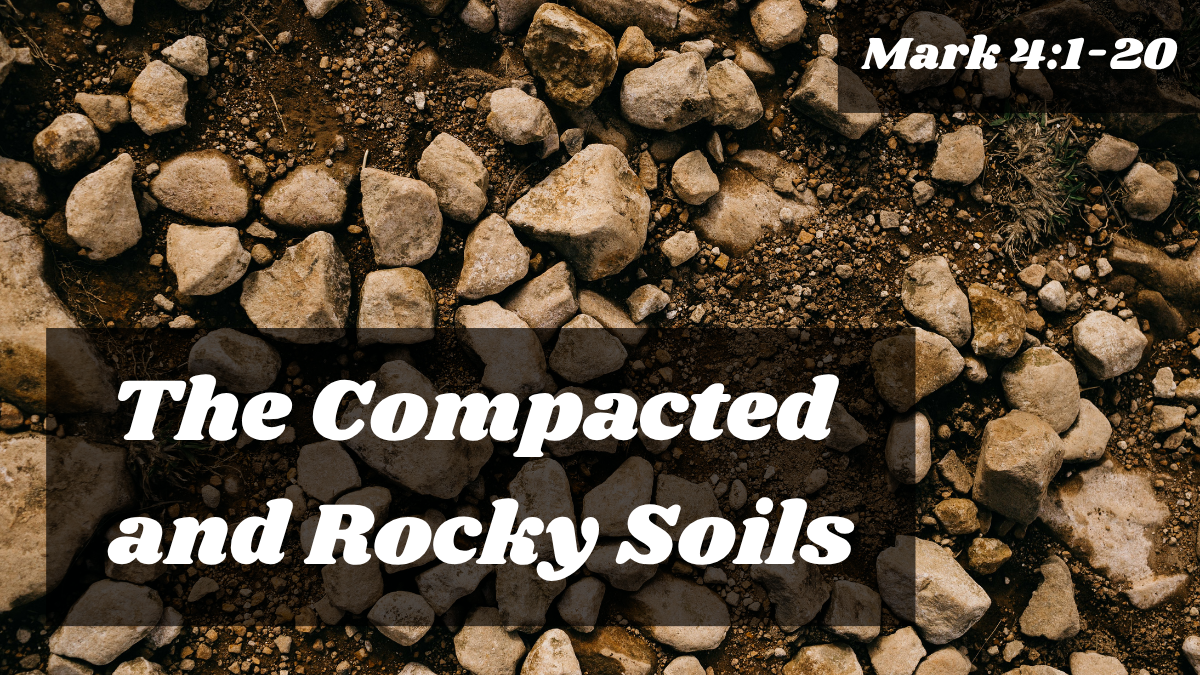
The second type of soil that Jesus talks about is rocky soil. In rocky soil, because the dirt is shallow, causes plants to grow rapidly. Where they would normally spend more time growing downward, unseen, becoming rooted, because of the rocks, they spring up quickly. Jesus says:
Others, like seed sown on rocky places, hear the word and at once receive it with joy. 17 But since they have no root, they last only a short time. When trouble or persecution comes because of the word, they quickly fall away.
Shallow faith, like shallow roots, creates tenuous belief. Everything may look good on the surface under ideal circumstances, but the moment that any sort of tension or trouble comes along—hard rains, high winds—their lack of rootedness is exposed. You’ve probably seen Christians like this. I’ve seen Christians like this. People have a culture of Christianity—they come to church, they do believe, they know the rituals, they enjoy the songs—but their faith is not rooted in anything of substance.
Rocky soil people have a shallow knowledge and experience of God. They are consumed with how they look on the outside. They want to grow the biggest plants, the most plants, foliage like you’ve never seen. But they trade their upward growth at the expense of downward rootedness. And then, when difficult times eventually come, everything gets washed away.
This shallow knowledge and experience comes from a lack of discipleship and a lack of ownership in one’s faith. Spiritual maturity does not come by proxy. I cannot give it to you, Pastor Sarah can’t give it to you. The desire for discipleship must come from within. The Barna Group, a few years ago, released the results of a study called “The State of Discipleship.” They asked people why they did not try to become more spiritually mature, or to continue Jesus’ analogy in this parable, why did they not seek to dig down deep.
Now you have to realize that the very question means that the individuals responding to it have already admitted that they are doing nothing to become more spiritually mature. 23% simply said that life was too busy. 8% were audacious enough to say they had other priorities that would come first. The most honest 16% said “It’s going to be a lot of hard work.”
And it is hard work. Digging deep means removing the rocks that are in us. There are things keeping us from rootedness. What are the rocks in your life? What are the things that keep you for deepening your relationship with God?
Digging down deep is hard work. It means removing the rocky soil, it means tilling the ground, it means making it a priority, it means setting aside time to focus on the work. It may mean deeply reflecting on the way we’ve built our lives and changing who we are and what we believe. But it’s worth it. Because the result is not only a better relationship with God, the result is a deeper impact for God and the realization of the meaning and purpose of your time here on this earth.
Let’s pray:
God the seed-sower, hear our prayer. We are hard pressed on every side, but not crushed; perplexed, but not in despair; persecuted, but not abandoned; struck down, but not destroyed. Keep us from being hardened like the path. Work within us to help us accept your word and to live like you. Help us grow in rootedness. May we be like a tree planted by streams of water, which yields its fruit in season and whose leaf does not wither. Grant us your strength, your mercy, your peace. Amen.