
Summary
What is the difference between simply believing in God and actually living by faith? This message explores the distinction between belief as knowledge and faith as belief put into practice. Drawing from James, Hebrews, Elijah’s confrontation with the prophets of Baal, and Jesus’ teaching about faith the size of a mustard seed, we discover that the power of faith does not come from how strongly we believe, but from the One in whom we place our trust. True faith is not about believing harder, demanding better outcomes, or placing ourselves at the centre—it is about confidently trusting Christ and allowing that trust to shape the way we live.
Outline
- Belief vs. FaithBelief acknowledges something as true, while faith puts that belief into practice through trust, commitment, and action.
- Faith Must Be LivedDrawing on James, the message challenges us to recognise that intellectual agreement or theological knowledge alone is not the same as a faith that transforms how we live.
- The Object of Our Faith MattersFaith itself has no magical power. The strength of faith depends not on the person believing, but on the trustworthiness and power of the one in whom that faith is placed.
- Faith Is Not About UsElijah’s confrontation with the prophets of Baal demonstrates that sincere, passionate belief cannot make an unworthy object worthy of trust. Faith does not create truth; rather, we place our faith in what is true.
- Faith in the Living GodWe do not need enormous or perfect faith to begin trusting Christ. Even faith as small as a mustard seed can grow when it is anchored in the living God.
Topics
Read the full sermon text
First of all, I want to thank JD and the leaders of the church for their willingness to invite me here to be part of what this church is doing. When I lived in England and even before that, in Tulsa, JD and I would call each other every so often and update each other on our lives and ministries. I remember him being a bit uncertain about joining this church as its pastor. But then I had years of phone calls where it was one thing after another about how the church was growing—spiritually, physically, in terms of community engagement.
And then I got to come visit and see how true all those things were and I knew that, for however long I was here and in whatever way I could, I wanted to lend my gifts and talents to the church. When I moved back here, I told God that I didn’t know what this transition period held for me, but I wanted to find out where God was working and go be a part of it. Well, I’ve been to this church, I’ve seen what y’all are doing, and I’m ready to be a part of it and serve however I can.
Belief vs. Faith
The first thing I want to do this morning is draw a distinction between belief and faith. We use those two words interchangeably. Sometimes that’s okay, sometimes it causes confusion. For example, when leaders of the church baptize folks, at least what I learned was that you lead the person being baptized into repeating the words “I believe that Jesus is the Christ, the son of the living God, and I accept him as my Lord and Savior.” And then, having heard that, the person doing the baptizing says “Based on your confession of faith, I now baptize you.” You have a statement that begins with “I believe” and we call it a confession of faith. We’re using those words like they mean the exact same thing.
But I want to propose we define them a little bit differently. I want to propose that belief is informational while faith is applicational. To have belief in something is to understand its existence or acknowledge its authority. Faith is to rely on that authority. In other words, faith is belief put into practice.
In Hebrews 11, the great “hall of faith” chapter of the Bible, the author of Hebrews lists a who’s who of Bible characters and commends them for their faith. And every single time, it’s by faith this person did this thing. Not thought this or believed this, but worked out their belief.
Belief is this large circle. Faith is this smaller circle within it. You can believe, but not have faith. You can believe, but not trust. You can believe in but not have faith in. The apostle James says that some so-called Christians are the same way. Oh, they have belief. They believe in Jesus Christ as Lord. They just aren’t doing anything about it. They never live out that belief in faith.
He has this whole section where he talks about how faith without works is dead. James chapter 2:
What good is it, my brothers and sisters, if someone claims to have faith but has no deeds? Can such faith save them? 15 Suppose a brother or a sister is without clothes and daily food. 16 If one of you says to them, “Go in peace; keep warm and well fed,” but does nothing about their physical needs, what good is it? 17 In the same way, faith by itself, if it is not accompanied by action, is dead.
That type of faith James is talking about is just belief. He says you call it faith. But there’s no evidence you believe. You’re not living out what you say you believe. You’re not living out what you say you have faith in. He says, verse 19:
You believe that there is one God. Good!
Congratulations. You’ve done the most basic thing in Christianity. You believe in God. A+ on the theology exam.
Even the demons believe that—and shudder.
You can feel the sarcasm dripping off his words. Oh, you believe. Congratulations. You and the demons both. You believe. You’ve officially reached demon-level on the theology chart. The demons believe God. The demons even fear God. In the New Testament, it’s a demon who is the first being to proclaim Jesus as Messiah. In Mark 1, at the beginning of Jesus’s ministry, he drives out a demon who greets him with:
“What do you want with us, Jesus of Nazareth? Have you come to destroy us? I know who you are—the Holy One of God!”
The demon has belief. The demon has knowledge. If you gave that demon a theology test, it would ace it. And not only does that demon know Jesus is Lord, it also acquiesces to that Lordship. Belief isn’t enough. Proclaiming that belief isn’t enough. You can know the Bible inside and out and that doesn’t mean you live it out. You can quote Scripture all day long and that doesn’t mean you have faith.
Demons have belief. They recognize the authority of Christ and the position of Christ, but they have chosen not to follow him—they do not follow in faith.
The Object of Faith
Okay, so we have to live out our belief. We have to commit to it. We have to not just say we believe, but we have to work it out. Now that can also come with its own problems. Because we can start to think that we are the ones in charge of our faith.
There’s a growing sentiment that the power of faith is in the faith itself. If only you believed harder you’d be healed. If only you had more faith, you’d have more money. When things don’t go our way or we go through times of suffering, we can begin to believe that if we just had more faith, these things wouldn’t be happening to us.
Basically, we make faith about us. We envision our faith as being the thing that provides power to the object of faith. But faith isn’t the thing. It’s the duty or allegiance to the thing.
Faith, in itself, means nothing. You can sincerely hold a belief and be sincerely wrong. Faith is merely the conduit. The power lies not in the faithful but in the object of faith.
The late Tim Keller wrote in his book The Reason for God:
“It is not the strength of your faith but the object of your faith that actually saves you. Strong faith in a weak branch is fatally inferior to weak faith in a strong branch.”
Do you follow me on this? We can make the mistake of thinking that the power of faith lies in us. In the Old Testament, the prophet Elijah challenges the prophets of Baal to a battle of the gods.
Then Elijah said to them, “I am the only one of the Lord’s prophets left, but Baal has four hundred and fifty prophets. 23 Get two bulls for us. Let Baal’s prophets choose one for themselves, and let them cut it into pieces and put it on the wood but not set fire to it. I will prepare the other bull and put it on the wood but not set fire to it. 24 Then you call on the name of your god, and I will call on the name of the Lord. The god who answers by fire—he is God.”
So this—the prophets of Baal think—is a challenge about who has more faith. Let’s see who can grab the attention of their god. The prophets of Baal go first and boy howdy do they have faith:
So they took the bull given them and prepared it.
Then they called on the name of Baal from morning till noon. “Baal, answer us!” they shouted. But there was no response; no one answered. And they danced around the altar they had made.
Here they are. They’re acting out their faith. They’re living it out. They are trusting in their faith and actions, their devotion to their deity. Maybe four hours go by and now it’s lunchtime.
27 At noon Elijah began to taunt them. “Shout louder!” he said. “Surely he is a god! Perhaps he is deep in thought, or busy, or traveling. Maybe he is sleeping and must be awakened.” 28 So they shouted louder and slashed themselves with swords and spears, as was their custom, until their blood flowed. 29 Midday passed, and they continued their frantic prophesying until the time for the evening sacrifice. But there was no response, no one answered, no one paid attention.
Man, I do not think I have this kind of faith. They’re dancing, they’re shouting, they’re cutting themselves. Daytime turns nighttime but there was no response, no one answered, no one paid attention. Now let me ask you this: was it their faith that had failed?
Or was their problem the deity in which they had placed their faith?
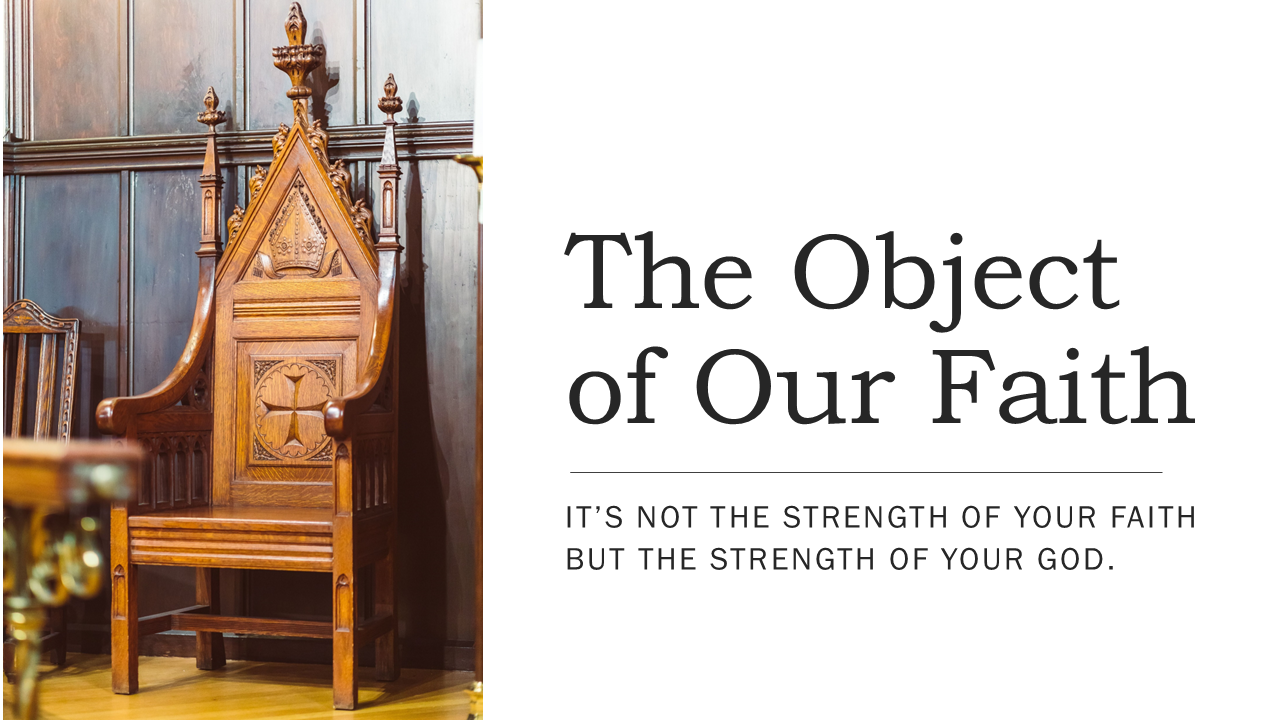
I’m going to illustrate it like this. I have this chair. If the power of faith is in faith itself, then I should have no problems here. I now proclaim that I have faith that this chair will hold me up.
So a fair amount of Americans—Christian and non-Christian—believe in the power of a sincere faith. They believe sincere faith creates truth. They believe that the act of believing makes things true. Instead of putting the object of their faith at the center, they put themselves.
Faith becomes about me and what I believe and what I want and what I like. “I believe it, therefore it is true.” When it should be “It is true, therefore I believe it.” And if faith is about me, then I have made myself God of my life. I have put myself above God.
So if faith is what creates truth, if faith is itself what holds power, then I should have no problem sitting in this chair.
I can have all the faith I want, this chair wasn’t going to hold me up. The amount of faith I have is useless if what I have faith in has no power. The power of faith is not in the person who has the faith, or in the action of faith, but in the object of faith.
Who you have faith in matters. Faith isn’t magical or mystical or irrational. Faith is real and substantial. It is confidence, not just in anything or anyone, but in Christ. Do you have that confidence, do you have that kind of faith in Christ?
After the failure of the priests of Baal to do anything, Elijah comes up and he creates his altar, prepares his sacrifice, and drenches the whole thing with water. Not the ideal way to start a fire. Then he says:
“Lord, the God of Abraham, Isaac and Israel, let it be known today that you are God in Israel and that I am your servant and have done all these things at your command. 37 Answer me, Lord, answer me, so these people will know that you, Lord, are God, and that you are turning their hearts back again.”
38 Then the fire of the Lord fell and burned up the sacrifice, the wood, the stones and the soil, and also licked up the water in the trench.
39 When all the people saw this, they fell prostrate and cried, “The Lord—he is God! The Lord—he is God!”
It’s a simple thing, this faith in God. It doesn’t require much. It doesn’t require much because it’s not about us. It’s about the power of the object of our faith. If I sit in this chair, I can have faith the chair will hold me, but it’s not my faith that makes it do so. It’s the integrity of the chair. The chair would have held me up, whether I had the faith to sit in or not. The quality or quantity of my faith makes no difference so long as I have faith enough to take a seat.
In the Gospels, Jesus is talking to his disciples about their lack of faith and he says:
“Truly I tell you, if you have faith as small as a mustard seed, you can say to this mountain, ‘Move from here to there,’ and it will move. Nothing will be impossible for you.”
Mustard seeds are small, about a millimeter in diameter. Jesus’s point is that you don’t have to have grand, ostentatious faith. If it exists at all, if you are tethered to the Christ the object of our faith in any way, that small faith will grow into something great, long-lasting, and bearing fruit.
Is your faith in broken chairs? Or is your faith in the living God?
God of small seeds and mighty plants, you take our lives and with your love cause them to produce acts of loving kindness for you in this world. You hear our cries and find us when we are lost and wandering in fear. You bring us home with you so that we may be made whole, rejoicing in your goodness. Help us to joyfully serve you all our days, knowing that you are always watching over us. In Jesus’ name, we pray, Amen.