
Summary
In John 6, Jesus feeds the hungry crowd, but soon challenges them to look beyond the bread they can eat and seek the deeper nourishment only he can provide. This message explores what it means for Jesus to be the Bread of Life—not simply someone we follow when faith makes life easier, but the one who transforms, sustains, and calls us to live differently. From the generosity of a child who offers his small lunch to Peter’s powerful question, “Lord, to whom shall we go?”, we are challenged to consider whether we are following Jesus for what we can receive or because we have discovered that there is nowhere else to go.
Outline
- Bread for the HungryJesus feeds the multitude and demonstrates God’s abundant provision for the whole person: body, mind, and spirit.
- More Than a MiracleThe feeding of the crowd reveals the kind of generous, sacrificial community Jesus is building, where even what seems small can be multiplied for the good of others.
- From Bread to the Bread of LifeJesus challenges the crowd not to seek him merely for physical provision, declaring instead: “I am the bread of life.”
- The Cost of Following JesusTrue discipleship means more than receiving benefits from Jesus; it requires allowing his life to transform us and following him into service, sacrifice, and sometimes difficulty.
- To Whom Else Can We Go?When many disciples turn away, Peter’s response becomes the central question for us: will we seek an easier path, or remain with the One who has the words of eternal life?
Topics
Read the full sermon text
Good morning! Thank you for having me today. My name is Josh. You’ve seen me around the last few weeks. I’ve really enjoyed getting to know all of you. You have been so friendly and welcoming to me and family and I thank you for that. Some of you probably already know that I am a pastor who has ministered in US and the UK and I now live here with my family. Simon and church leadership invited me to share with you this morning on John 6 and let me just say that it is an honor and a privilege.
Before we begin, let’s pray: Father God, hear our prayer. We gather here today in community—not just with one another, but with you, and as part of churches gathering all throughout Victoria, and Australia, and the world. We gather to worship you, to be challenged by your word, to grow deeper in our knowledge and fellowship. You are the God who reveals, not a God who is hidden. Reveal to us what you have be reminded of in this passage. In the name of Jesus, Amen.
Alright, Simon has been taking us on a journey through the gospel of John and we’ve come to John chapter 6. And oh boy are there so many things to talk about in John 6. This is a chapter that begins with the Feeding of the 5,000 with five loaves of bread and two fish. It moves from there to Jesus walking on water, the first of seven I AM statements where he calls himself the Bread of Life, and then ends with many of his disciples falling away and that famous passage from Simon Peter when Jesus asks if the twelve, his closest disciples, will leave him as well. Peter says “Lord to whom shall we go? You have the words of eternal life.”
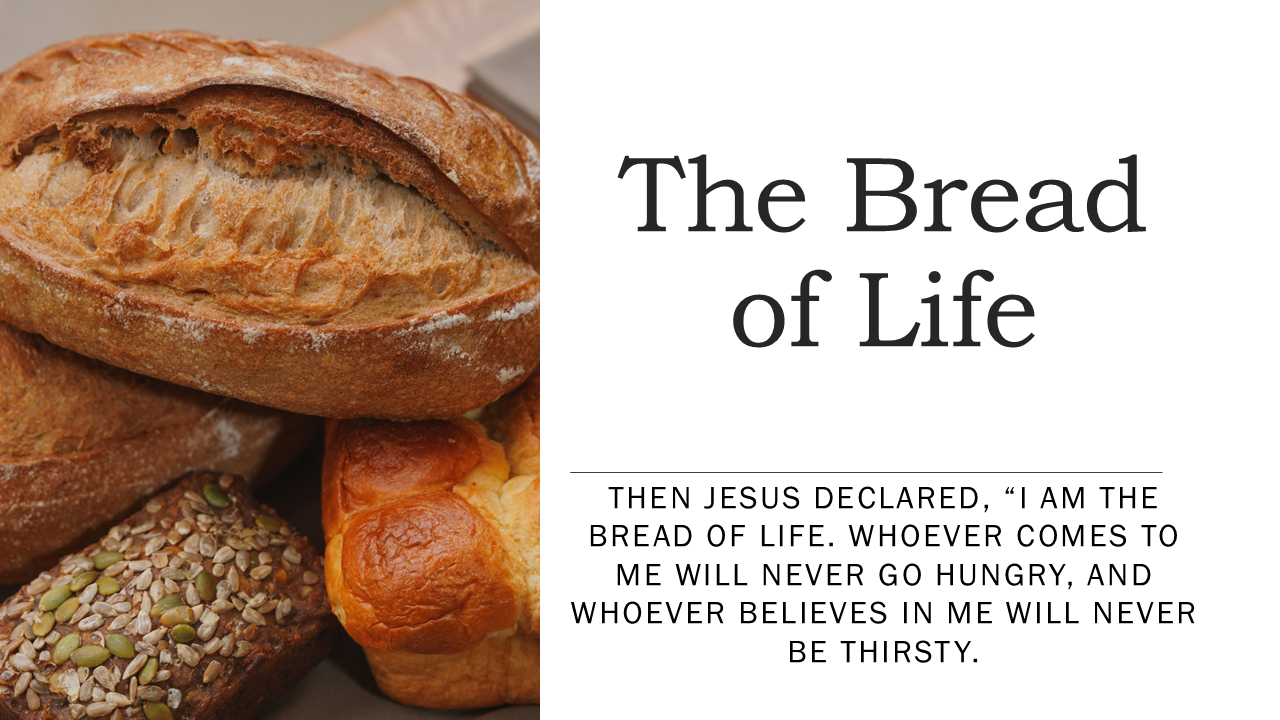
And the central theme throughout that whole chapter is bread. So I brought some bread. And we’re going to put it here to look at while I’m talking. Bread is an amazing food. One of my favorite foods. It’s so versatile. You’ve got sourdough and multigrain and ciabatta and brioche and white bread and rye bread and wheat bread.
And here’s one that I didn’t know existed until I moved here to Australia. Fairy bread. I took my son to his first Aussie birthday party for a mate of his. And I’m like what’s this? It’s bread with sprinkles on it. Excuse me, hundreds and thousands on it. Which, by the way, love the name. Americans are like we’ll sprinkle a few on this. And Aussies are like “We’ll put hundreds and thousands on it.”
Bread is everywhere. That’s something we have in common with the ancient world. Except they didn’t have fairy bread. Bread wasn’t meant as a treat or a sweet or a side to the main meal. Bread was what kept them alive. It was the central food of life. In the Lord’s Prayer, Jesus is teaching his disciples how to pray and he tells them to pray “Give us this day our daily bread.” And bread there was a symbol for everything we need in our day to function and flourish.
So we get to John chapter 6 and a large group of people have followed Jesus because he’s been doing all these miracles, healing all these people of their various sickness and infirmities. Jesus gets away on a mountainside with his disciples, but the crowds follow him. Now John kind of skips over part of the story because he’s in a rush to talk about the miracle, but Matthew tells us that Jesus spends all day taking care of these people, teaching them, healing them, being with them.
Now it’s evening and they’re hungry. And Jesus says to Philip, John 6 verse 5: “Where shall we buy bread for these people to eat?” Now this crowd is five thousand men not including women and children. Let’s just double it and say ten thousand. That’s a lot of bread. Verse 7:
Philip answered him, “It would take more than half a year’s wages to buy enough bread for each one to have a bite!”
Philip gives a rational answer. He looks at the crowd, does a quick estimate, immediately realizes that logistics aside—it’s not financially feasible. Andrew, Peter’s brother, says:
“Here is a boy with five small barley loaves and two small fish, but how far will they go among so many?”
I don’t know for sure, but this sounds like sarcasm to me. “Well, he came prepared. We could take his lunch.” And that’s exactly what Jesus does. He takes this small boy’s lunch. 5 loaves, 2 fish. He thanks his Father for providing and then verse 11:
Jesus then took the loaves, gave thanks, and distributed to those who were seated as much as they wanted. He did the same with the fish.
It’s incredible. It is a miracle. Jesus—creator, provider, sustainer—look at what he’s done. He’s cared for them. He’s healed them. He’s pastored them. He’s taught them. And now he’s fed them. Mind, body, and spirit. He’s addressed their whole person. Top to bottom, inside and out. He meets their physical, emotional, and spiritual needs.
The people recognize this and they start to believe he’s the Messiah. They want to make him their king by force. But Jesus isn’t up for that and he just sort of slips away by himself. The next day, the people go looking for him. They want more. They aren’t satisfied. But they aren’t looking for him for the right reasons.
Jesus answered, “Very truly I tell you, you are looking for me, not because you saw the signs I performed but because you ate the loaves and had your fill.
Jesus sees them for who they are. They’re willing to follow him, they’re willing to serve him, so long as they get what they want out of it. So long as he makes their life easier. I mean why work all day to buy bread when this guy can just make it appear? Jesus has been trying to teach them about God. He’s been trying to draw them into a community where everybody takes care of everybody and nobody has their needs left unmet.
Think of how feeding all those people worked. It took one child willing to give of what he had to feed the community. Feeding the 5,000 wasn’t just about feeding the 5,000. It was about showing them how community worked, about how the Kingdom of God would work. How the small sacrifice of a young child—one person who trusts God and gives what they have to care for others, even if they know that’s not a lot, even if it doesn’t feel sufficient—God can multiply that into abundance. That’s the community Jesus is trying to build. That’s the church, if you will, that Jesus is trying to build. There is a word to the church here. You may feel small, insignificant, under-resourced, unable to do what you would want to do. And Jesus says if you give what you can, he will take it and multiply it, and make it into abundance.
But they just saw the miracle. They ignored the teaching. They forgot the point of why Jesus did what he did. They got hungry again and went back for more bread. They are willing to serve God so long as it provides a good return on their investment. They will follow Jesus wherever he goes so long as he keeps their bellies full.
These fair-weather friends are using Jesus for what they can get out of him. So long as he gives them health and wealth and vitality, they’re on his team. They want to make him their king so that he can defeat the Romans and return Israel to the good old days. They’re willing to follow him so long as following him is easy, so long as he takes care of all they need. And Jesus confronts them on that.
He says, verse 27, “Do not work for food that spoils, but for food that endures to eternal life.” In other words, don’t follow me because I gave you bread. Follow me because I am the bread. Don’t be in this because I make your life easier. I won’t always do that. Be in this because I will make your life different. And that’s going to be hard. The disciples that were following Jesus had already experienced this. They had walked away from respected professions, from places of stability, from wealth, to follow Jesus.
Jesus has called the people to live differently, to love their enemies, to care for the most vulnerable, to give generously and sacrificially, to challenge the values and priorities of the world around him. Jesus loves people nobody else wants to love. He spends time with tax collectors and sinners. He doesn’t live in wealth, he doesn’t even have a home. Following Jesus, doing the things Jesus does, it’s not comfortable. This is a hard thing that Jesus is doing. They want to follow up and reap the reward but not follow him and do what he does.
They actually have the audacity to ask him to be more like Moses.
So they asked him, “What sign then will you give that we may see it and believe you? What will you do? 31 Our ancestors ate the manna in the wilderness; as it is written: ‘He gave them bread from heaven to eat.’
He’s just fed them. He’s healed their sick. He’s cared for these people. And when Jesus says “Follow me means being doing what I do” they get mad. “Well, maybe you’re not the Messiah. Give us a sign. Prove it. Why can’t you be more like Moses? He fed millions every day during our forefather’s wanderings.” And they begin telling Jesus what a Messiah would do.
Jesus says, look, first of all. God gave you that bread, that manna from heaven, not Moses. But second, verse 32:
it is my Father who gives you the true bread from heaven. For the bread of God is the bread that comes down from heaven and gives life to the world.”
Jesus is setting up this contrast between then and now, between Moses and himself. In the time of Moses, God gave them manna from heaven to care for their physical needs. But now, a different kind of bread has come down from heaven—a spiritual, eternal bread that takes care of spiritual, eternal needs.
Then Jesus declared, “I am the bread of life. Whoever comes to me will never go hungry, and whoever believes in me will never be thirsty.
It’s this beautiful, wonderful statement that Jesus is what we need. Bread is central to the provision of physical life. Jesus the bread of life is central to the provision of spiritual life. Jesus is the one who makes us spiritually alive. He redeems us. He saves us. He makes us new. He gives us strength to face the day. He radically changes us.
He changes our desires. He pushes back against who we are until we are molded into who he wants us to be. Following him requires us to actually follow him. To go where he goes. To do what he did. To live and to give and to serve and to sacrifice as he did. He is our bread who sustains us to live this life he has called us to live.
As soon as Jesus says this, he gives them a rebuke. Verse 36:
But as I told you, you have seen me and still you do not believe.
They have seen the bread of life. But they won’t believe. They won’t make it part of their lives. They won’t consume it. That’s what you have to do with bread. You have to eat it. It does no good to look at it. To put it on a pedestal. These people won’t allow themselves to be affected by it. They’ll make an idol out of it, pretend to worship it, even. They’ll claim to love the bread—but they won’t make it a part of them.
When you eat bread, it changes you. It becomes part of you. It nourishes you. Sustains you. Gives strength for the day. Jesus says faith must work the same way spiritually. In the ancient world, it was the fuel of physical life. But you had to eat it. It had to get inside of you and do its work. Jesus is saying that bread is essential to your physical life. I am essential to your spiritual life. Those who follow him must allow himself to become a part of them.
Jesus continues, verse 51:
I am the living bread that came down from heaven. Whoever eats this bread will live forever. This bread is my flesh, which I will give for the life of the world.”
And those that have been following Jesus for their physical benefits won’t do so any longer for their spiritual benefit because the cost is too great. They’ll have to give up too much. The path is too narrow. The way is too hard. Theologian J. Ramsey Michaels writes:
It may be that to eat Jesus’ flesh and to drink his blood implies not only benefitting from his death but to some degree sharing or participating in that death.
So they no longer want to follow him. Verse 66:
From this time many of his disciples turned back and no longer followed him.
They were with him until they saw where he was going. They followed him up until they saw it would lead to the cross. They say they are going away because they don’t understand him, but the truth is that they’ve found that following him isn’t as easy as they hoped it would be.
Jesus is often rejected, not because he is unknown or misunderstood, but because the path to him is not the path folks want to follow. For broad is the way and wide is the path that leads to destruction, Jesus said in his Sermon on the Mount, but straight is the gate and narrow is the way that leads to life, and there be few that find it. G.K. Chesterton wrote:
“The Christian ideal has not been tried and found wanting. It has been found difficult; and left untried.”
When the crowd learned that the path to victory led through the cross, they abandoned him. Understanding who Jesus is doesn’t make following him easier, it makes it harder—but it makes it more compelling, and worth it. I’ve followed Jesus for most of my life. I’ve followed him down to my last dollar and into churches and circumstances and countries that I would not ever have expected.
He’s put me into some uncomfortable situations to preach the Gospel, to care for others, to be a faithful presence in the communities he’s put me in. I’ve followed him as he’s led me around the world. It’s been an adventure but it has cost me. It’s been difficult. Following God is not easy. But man is it worth it. We finish out the chapter and Jesus looks forlornly to the disciples:
67 “You do not want to leave too, do you?” Jesus asked the Twelve.
68 Simon Peter answered him, “Lord, to whom shall we go? You have the words of eternal life. 69 We have come to believe and to know that you are the Holy One of God.”
That’s where I leave you today. The crowd looks at what Jesus is asking of them and they say “Is there anyone else?” Peter looks at him and says “Who else can there be?” We have the choice today to be the crowds or to be Peter. We can look around for other food, for other leads, for other faiths. We can try to find an easier way. Or we can look to Jesus. Jesus who kept us this far. Jesus to has been with us through all the ups and downs of life. Jesus who has been our Comforter in times of sadness, our Help in times of weakness, our Friend in times of loneliness, and our Savior, Messiah, and Lord.
To whom else can we go?
Jesus invites us to be part of him, to be part of what he is doing in the world. To partake of him and allow his life to work in us. There’s an old story from Billy Graham telling a child about who he was and what he did and Graham said to the boy that he tells people how to have Jesus live inside of them. And the boy ponders this and “I reckon he wouldn’t fit. I bet he’d stick out.” And Graham says, You’ve got it. That’s the whole idea. You put him in your heart and then he sticks out.