
Summary
Growth is rarely comfortable. In this message, we explore Jesus’ parable of the soils alongside the biblical images of refining fire, the potter’s clay, and spiritual discipline to discover a central truth: growth hurts, growth requires change, but growth leads to flourishing. Whether in our individual lives or in the life of the church, becoming more receptive to God often means allowing old patterns, priorities, and obstacles to be broken up, removed, and transformed. The process may be difficult, but when we trust God through the discomfort of growth, we become more mature, more fruitful, and more fully the people God has called us to be.
Outline
- Growth HurtsFrom physical growing pains to spiritual maturity, growth often involves discomfort, disruption, and difficulty.
- Becoming Good SoilJesus’ parable of the soils shows that spiritual fruitfulness requires us to break up hardened places, deepen our roots, and remove the weeds that choke out growth.
- The Work of TransformationScripture compares spiritual growth to refining gold in fire, shaping clay in the hands of a potter, and the discipline required for training. God’s work in us is not always comfortable, but it is purposeful.
- Growth Requires ChangeNeither individuals nor churches can grow while insisting on doing everything exactly as they have always done. Growth requires new ways of thinking, living, serving, and sharing responsibility.
- The Result Is FlourishingWhen we embrace the pain and change of spiritual growth, we mature into fruitful people and communities, growing together in love with Christ at the center.
Topics
Read the full sermon text
When I was thirteen years old, my knees and heels began to hurt. I couldn’t sit with my legs bent for any period of time or else my knees would hurt when I straightened my legs. I couldn’t run for any length of time because my Achilles tendons would have these shooting pains that ran up and down my calf. My parents took me to the doctor and the doctor wasn’t all that concerned. “They’re growing pains.” And within a one-year period, I grew about six inches and gained about sixty pounds. Growth hurts.
I grew up, became a competitive gymnastics coach, and began to work with kids—boys mostly—that were all hitting that growth spurt of puberty and it changed the way they did gymnastics. Some of you might remember the 2020 Olympics when Simone Biles dropped out of the competition because she suddenly lost her sense of where her body was at in the air. I had a lot of gymnasts go through that as they grew. As they grew, it changed their center of gravity. It changed how close they were to the ground, how many steps they needed to run. Sudden growth can change your whole sense of self. Growth hurts. Growth requires change.
There’s today’s sermon in a nutshell. Growth hurts. Growth requires change. There’s a parable that Jesus preaches in the Gospels—and it’s recorded in three of the four Gospels, so you know it’s important. We often call it the parable of the sower, but I like to call it the parable of the soils. Because the primary focus of Jesus in this story isn’t on the farmer who sows the seed but on the receptiveness of the soils to that seed.
There are four types of soil in this parable: compacted soil (the path), shallow soil, crowded soil, and good soil. Jesus says
“The farmer sows the word. 15 Some people are like seed along the path, where the word is sown. As soon as they hear it, Satan comes and takes away the word that was sown in them. 16 Others, like seed sown on rocky places, hear the word and at once receive it with joy. 17 But since they have no root, they last only a short time. When trouble or persecution comes because of the word, they quickly fall away. 18 Still others, like seed sown among thorns, hear the word; 19 but the worries of this life, the deceitfulness of wealth and the desires for other things come in and choke the word, making it unfruitful. 20 Others, like seed sown on good soil, hear the word, accept it, and produce a crop—some thirty, some sixty, some a hundred times what was sown.”
Now I could preach a sermon—and I have before—on each of these different soils. But ain’t nobody got time for that today. Today, I want you to notice the progression in the soils. The first soil is compacted. It’s so beaten down and trampled on that it cannot receive the word of God. The second soil is shallow. The rocks in the dirt prevent the seed from sprouting with any sort of rootedness and as a result the soil’s reception of God is shallow, unstable, and short-lived.
The third soil could be good soil, but there’s all these weeds and thorns among it. Jesus says the weeds and thorns are the worries of this life, the deceitfulness of wealth, and the desires for other things. And all of these things steal life from the seed. They block it from the sun above them and suck up the nutrients in the soil beneath. Then there’s the good soil. It’s deep, good soil. It has been tilled up so it’s not compacted. It’s been worked through so that the rocks have been removed. It’s been tended to and weeded so that the thorns can’t choke out life.
And this represents a progression in the life of a Christian and in the life of a church community. You might begin hard, beaten down, resistant to the message of God but you can become good soil. Now how is it that we grow into being good soil? What creates good soil?
Creating good soil requires working the earth. You have to break it up. You have to work through it. Now dirt isn’t sentient. This doesn’t bother the dirt in any way. But people are. And we don’t like disruption. We don’t like things that hurt. Now imagine what this feels like. You scrape and dig and pluck and pull and weed and thoroughly work through the soil. Now it can be receptive to the word. Now it can be good soil. But the process isn’t always a fun one.
A different metaphor that Scripture uses for this process of growth is a refiner’s fire. The Apostle Peter uses this metaphor when he is writing to a growing church facing difficulties when he says
In all this you greatly rejoice, though now for a little while you may have had to suffer grief in all kinds of trials. 7 These have come so that the proven genuineness of your faith—of greater worth than gold, which perishes even though refined by fire—may result in praise, glory and honor when Jesus Christ is revealed.
Peter is saying that growth is hard. Physical growth is hard. Spiritual growth is hard. It’s like being refined by fire. The gold ore is mined. It’s not pure. It gets thrown into the fire. Not for destruction, but for the burning away of impurities. The dross, all the impurities, rise to the top, get scraped off, and the process continues again and again until the gold is purified.
This is an intense process. It doesn’t sound like fun. Let’s go to one more metaphor for spiritual growth. Isaiah writes:
“Yet you, Lord, are our Father. We are the clay, you are the potter; we are all the work of your hand.”
Paul says in Ephesians:
For we are God’s handiwork, created in Christ Jesus to do good works, which God prepared in advance for us to do.
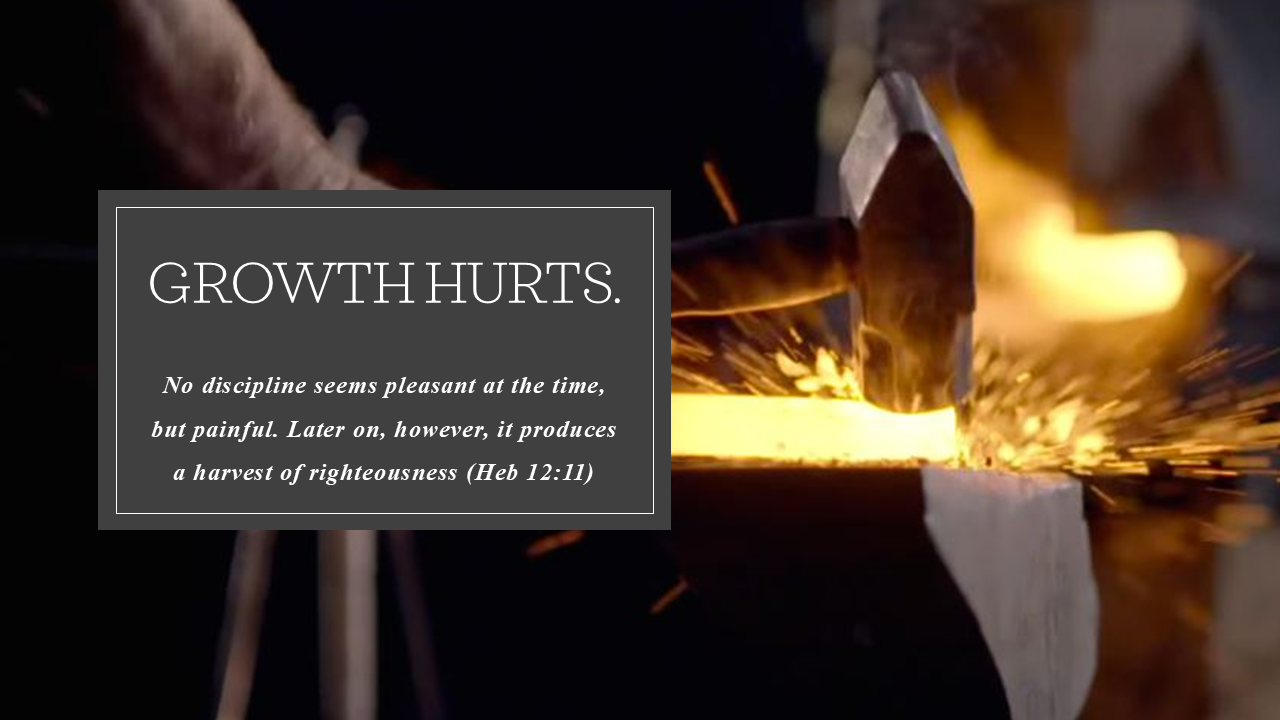
So you have this picture of a lump of clay. That’s what you are. A lump. And God begins to mold you and work the clay and carve into it and then you go in the fire, in the kiln, so that you can become this piece of pottery. Whether it’s dirt or gold or clay, the consistent imagery of spiritual growth throughout Scripture is that growth hurts. Growth hurts. This process of sanctification, of becoming more receptive to the word and will of God. It’s like a claw through the heart. It’s like searing fire. It’s like strong hands pushing and bending you a certain way. The author of Hebrews puts it this way:
No discipline seems pleasant at the time, but painful. Later on, however, it produces a harvest of righteousness and peace for those who have been trained by it.
We tend to think of discipline as synonymous with punishment. It isn’t. Discipline is training. It’s the same root word we get discipleship from. This process of spiritual growth—as an individual, as a church—requires discipline and discipleship. And it’s not easy. It’s hard. It doesn’t seem pleasant at the time. But just like that tilled earth, it produces a harvest of righteousness and peace. It produces—here’s another biblical metaphor—good fruit.
In his book Spiritual Leadership, Oswald J. Sanders, adapts a poem from the twentieth-century poet Angela Morgan to talk about this concept of sanctification:
When God wants to drill a man
And thrill a man
And skill a man,
When God wants to mold a man
To play the noblest part;
When He yearns with all His heart
To create so great and bold a man
That all the world shall be amazed,
Watch His methods, watch His ways!
How He ruthlessly perfects
Whom He royally elects!
How He hammers him and hurts him,
And with mighty blows converts him
Into trial shapes of clay which
Only God understands;
While his tortured heart is crying
And he lifts beseeching hands!
How He bends but never breaks
When his good He undertakes;
How He uses whom He chooses
And with every purpose fuses him;
By every act induces him
To try His splendour out–
God knows what He’s about!
We go through this sanctification, we go through this growth, we submit to this discipline—because the end result is that the pain is worth it and we trust the vision of the master creator to do a work in us and crafts us and molds us into the people and the churches they have called us to be.
So growth hurts. Second, growth requires change. Gail Sheehy, an American journalist, once wrote that “If we don’t change, we don’t grow. If we don’t grow we are not really living.” The same is true for the Christian life. At the end of 2 Peter, Peter’s final words to his audience is an exhortation to growth: “But grow in the grace and knowledge of our Lord and Savior Jesus Christ.”
The Christian life is a life of continual becoming. We never reach a place where we have it all figured out, where we’re doing everything right, or have everything in place. Growth means we do things differently now than we did before. I’m going to give you another gymnastics metaphor. A central component to gymnastics is knowing where your body is at in space. When your body grows, suddenly your rhythm is off, your timing is off, your sense of where you are is off. And as a coach, my job is to get those kids to change the way they’ve always done things to a new way of doing that fits the growth of their body.
The same is true in the Christian life. The same is true for the life of a church. Let’s think of it practically. A church of thirty people is going to necessarily function differently than a church of one hundred people. A church of one hundred people is going to function differently than a church of one thousand people. And the way that churches grow physically, numerically, is by recognizing when it is time to change to allow growth. They add more staff, cultivate more volunteers, begin more programs. And the way in which they do these programs becomes more organized even as it becomes more complex. For the church to grow, things have to change.
And this can be a difficult thing for the church because well that’s not the way we’ve always done it. That feels unfamiliar. It feels a little uncomfortable. It requires a sharing of power. These are all problems that churches run into when they grow.
When I was a youth pastor in Tulsa, we had about twenty kids in our youth group—all from church families, all of whom went to the same two schools, all of whom had families that spent time with each other. Then, the church started to attract the attention of the community. This is growth. This is good. But it radically changed the context and the needs of the church. Because this growth was new people—different ethnicity, different socioeconomic background, different spiritual background, different needs—and that was difficult. Growth required change.
We see things like this in the early church. After Pentecost, the church is growing. A lot of Gentiles are coming to faith in Jesus. And there’s this central problem of the early church: how Jewish is Christianity? While some wanted these incoming believers to become Jews and adhere to Jewish rituals (Acts 15:5), the early church leaders determined that “we should not make it difficult for the Gentiles who are turning to God” (Acts 15:20b) and gave only a few conditions for the Gentile church to follow. This wasn’t an easy change for the church. They are changing long-held cultural rituals and changing generational practices in order to accommodate this new growth in the church.
And it’s not just the physical growth of the church, it’s the spiritual growth of the individual and the community. Growth requires change. When you become a Christian, that’s not the end of the journey—it’s the beginning of one. There’s this passage in 1 Corinthians where Paul is talking about arguments within the church and how that infighting was hurting the church. I’m going to use the Message version to paraphrase this:
Don’t you realize that this is not the way to live? Unjust people who don’t care about God will not be joining in his kingdom. Those who use and abuse each other, use and abuse sex, use and abuse the earth and everything in it, don’t qualify as citizens in God’s kingdom. A number of you know from experience what I’m talking about, for not so long ago you were on that list. Since then, you’ve been cleaned up and given a fresh start by Jesus, our Master, our Messiah, and by our God present in us, the Spirit.
Paul goes through this list of who the church in Corinth was once and then he says and that is what some of you were—not are, not continue to be—but you changed, you were washed, you were sanctified, you were justified in the name of the Lord Jesus Christ and by the Spirit of our God.
Change isn’t easy, but it’s necessary. Change is getting the rocks and weeds out so that we can flourish. And it’s continual. You don’t weed the garden once and that’s the end of it. I wish. You gotta keep working at it, going over it again and again to keep the weeds and thorns away. It’s hard work.
And when you do this. When you go through the pain. When you go through the discomfort. When you go through the changes necessary for growth. The result is spiritual maturity. Growth hurts. Growth requires change. But the result of growth is flourishing.
In Ephesians, Paul is talking about spiritual maturity and he says this flourishing end goal looks like this:
speaking the truth in love, we will grow to become in every respect the mature body of him who is the head, that is, Christ. 16 From him the whole body, joined and held together by every supporting ligament, grows and builds itself up in love, as each part does its work.
That’s our goal. That’s what we look toward. We grow and change and love—and through that we flourish. We flourish as a church. We flourish as a family. We flourish as an individual. With Christ as the center, we grow into an ever-changing ever-growing model of who Christ has called us to be.