
Summary
In the first message of his series on the seven last words of Jesus, Dr. Josh Olds examines the prayer “Father, forgive them, for they do not know what they are doing.” He walks through its three parts: the invocation, which shows Jesus’ unbroken relationship with his Father; the supplication, in which Jesus extends forgiveness to his enemies, from the Roman soldiers to the Jewish leaders to us; and the argumentation, which reveals that ignorance is not innocence. Along the way he explains that Christ’s forgiveness is not merely a change of heart but a costly canceling of debt paid through the cross, and he closes by calling the forgiven to become forgivers.
Outline
- Why a Dying Person’s Last Words MatterAcross history, last words have been treasured as a person’s final summation, advice, or request, and the seven sayings of Jesus from the cross, spoken through agonizing pain, show what was most on his mind.
- Invocation: Jesus Prays to His FatherEven in the worst of suffering, Jesus calls out to “Father,” modeling how we are to bear our own crosses, and as humanity’s representative he asks the Father to forgive rather than exercising his own divine prerogative.
- Supplication: Forgiveness for His EnemiesJesus lives out his command to love our enemies by praying for the Roman soldiers, the Jewish leaders, and all of us, and by asking the Father to forgive he shows that the offense is against God, so no one can hide behind a job, a law, or a culture.
- Apheimi: Forgiveness Is CostlyRather than simply ceasing to feel resentment, Jesus forgives by taking on the debt, and the Greek word for forgiveness means to release or separate, so that on the cross our sin was separated from us and paid in full.
- Argumentation: Ignorance Is Not InnocenceJesus appeals to his accusers’ ignorance, yet they ought to have known, so the sermon calls us to make the cross about Christ rather than ourselves and to let the forgiven become forgivers.
Topics
Read the full sermon text
We are beginning a new series today on the last words of Jesus. They aren’t his last words, of course, because of his Resurrection, but they are his last words before his death. In many Christian circles, these words have taken on important, ritual meaning. Some Lutheran churches celebrate Good Friday with a Tre Ore service—a three-hour long service that meditates on these seven last words. Interestingly, they choose three hours because it represents the three hours of agony that Jesus felt on the cross. I don’t know, I wouldn’t want to compare any church service to three hours of agony and I promise you that I’ll keep it to our normal length of time today.
These seven sayings are collected from the four Gospels. The cry of abandonment comes from Matthew and Mark. Three statements come from the gospel of Luke. Three from the Gospel of John. Over the length of all four gospels, these are the only sayings of Jesus recorded from the cross.
Perhaps he spoke more. Perhaps there was something said that none of the four Gospel writers felt compelled to include, but it’s unlikely. Crucifixion is a terrible death. It’s—well—excruciating—literally that word means out of the cross. The pain and agony are unbearable. As one hangs on the cross, the nails digging into the space between the radius and ulna bones in the arm, it becomes almost impossible to breathe.
Breathing requires pushing upward off the spike driven through the Achilles tendons and allowing the muscles in the arms and chest to relax and allow air into the lungs. Each saying of Jesus on the cross would have been made only through deliberate and agonizing pain.
Also, it’s highly doubtful that the Gospel writers would leave out any of these known last words of Jesus. Last words hold importance in culture throughout human history. They are the dying person’s final impartation to the recipient. One last declaration. One last admonition. One last request. One final articulated thought.
Almost as long as there has been written history, there have been accounts of last words. Volumes have been written on alleged last words of the rich and famous, some more credible and substantial than others. Oral history and folklore is replete with deathbed confessions and deathbed conversions—with occasionally those two being related to the other.
Edward Le Compte, author of the Dictionary of Last Words, wrote in his introduction:
Dying words have a better than usual chance to survive. There are reasons, reasons rooted very deep in human nature, why men pay particular attention to them and preserve them.
At times, dying words provide for us a summation of the life that had been lived. Josef Stalin, the brutal dictator of Russia from 1922 to 1952, had a long history of antagonism toward God. At one time a seminary student, he lost his faith in God and set about persecuting the church once he was in power.
Under his leadership, the Russian Orthodox Church was nearly obliterated, with nearly all of its clergy, and many of its believers, killed or sent to labor camps. Between 1927 and 1940, the number of Orthodox churches in Russia fell from almost thirty thousand to under five hundred. In 1932, Stalin initiated a Five Year Plan of Atheism and proclaimed that “the very concept of God must be banished from the Soviet Union.”
On his deathbed in 1953, the one-time seminary student, gave not so much a final word as a final action. He sat up in bed, clenched his first toward heaven, and then he was gone. An entire life, an entire legacy, summed up in this one final defiant action.
Last words are also meant to spur the living onward, to continue the work began by the dying, or to provide the last bits of advice before passing.
In a survey conducted by Perfect Choice Funerals, 83% of people said that their loved one’s last words were some sort of command or piece of advice. Of those, 21% said they were admonished to right past wrongs. 62% were given relationship advice, while 56% were given a word about their careers.
It’s no wonder, then, that Christians throughout the ages have latched onto these seven last sayings of Jesus from the Cross. They must have been important. Shakespeare, in his play retelling the life of Richard II, writes:
O, but they say the tongues of dying men
Enforce attention like deep harmony:
Where words are scarce, they are seldom spent in vain,
For they breathe truth that breathe their words in pain
I don’t know if that’s true, but I know that it’s true for Jesus. These final words hold great value for us as we consider what Jesus felt was important to address from the elevated pulpit of the cross.
Forgiveness
What is the first word from the cross? As a sheep before his shearers is silent, so he opened not his mouth. His only words to the High Priest: a proclamation that he was Messiah. His only words to Pilate: a confirmation that he was Messiah. But other than that, silence.
When he was accused by the chief priests and the elders, he gave no answer.
13 Then Pilate asked him, “Don’t you hear the testimony they are bringing against you?” 14 But Jesus made no reply, not even to a single charge—to the great amazement of the governor.
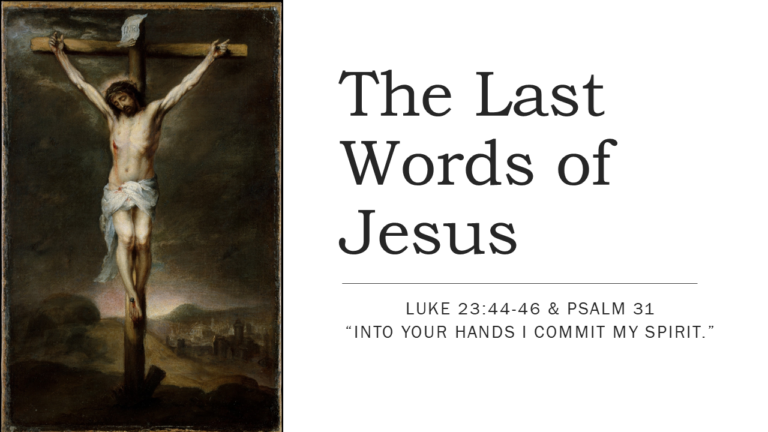
But then he is taken to the cross. Spikes driven into his wrists and feet, his nerves crushed, his blood vessels pierced, his muscles torn. The base of the cross is aligned with a hole dug deep into the ground so that it can stand sturdy for as long as it is needed. With ropes, the Roman soldiers raise Jesus up, and then with a crash, the cross would find its place and sink into the earth with a jarring intensity.
I’ve stubbed my toe before, and my audible response was not something I would want repeated from the pulpit. Jesus is nailed to a cross and, through the intensity of that pain, his first words are not ones of condemnation, insult, or cursing. It is a prayer of forgiveness.
He pleads with the Father to forgive those causing him pain.
He had no words for his accusers, but now to his God and Father he lifts his voice.
“Father, forgive them, for they do not know what they are doing.”
There are three parts to this simple, one-sentence prayer. The invocation, the supplication, and the argumentation. First, he directs his address. Then he gives his plea. Then he gives his reasoning.
Invocation
The first word that Jesus says from the cross is “Father.” Even on the cross, his relationship with his Father is unbroken. It does not even take close to a cross for us to question our relationship with God. Amid any time of loss or pain or hardship, there must come the question “Does God care?” or “Is God doing anything for me?”
James Stalker writes:
When righteousness is trampled underfoot and wrong is triumphant, faith is tempted to ask if there is really a God, loving and wise, seated on the throne of the universe, or whether, on the contrary, all is the play of chance
It would have been natural for Jesus to have abandoned his Father, even in that inscrutable relationship of the Trinity, Christ in his humanity must have felt what we all feel. Where is God when things go wrong? We even hear that tinge in his voice later in the fourth word—My God, My God, why have you forsaken me?
In his humanity, he may have felt as if God was forsaking him, but never did he waver or even think of forsaking God. Going through the worst of all experiences, where every sin was laid upon his shoulders, he calls out to his Father.
He prays. He models for us what we should do in our own humanity when we follow the call to take up our own crosses and follow him. Those crosses will carry us through some dark places. Not the around the valley of the shadow of death, but through it.
The Christian life is not one of ease or luxury, it is a life of the cross. And Christ’s cross was to bear the sins of the world. What are ours? What crosses has he called us to bear? In what ways has he called us to die to self in order to live for him?
And how shall we do it? We could not bear the weight of sin; how shall we bear this weight of a cross? Jesus models it for us. He calls out to his Father. He prays. This is the only thing that can sustain us in our Christian life. We see it throughout the Gospels. Jesus constantly goes away to pray. He communicates with his Father to make sure that he is on point in his mission.
I do not know what crosses you are bearing. I do not what mission God has put you on or what passion he has laid upon your heart. For my family, in this season, it is adoption. For others, it might be VBS. It might be feeding the poor, healing the sick, or modeling any one of the things Jesus did as part of his mission. To bear that cross well, you must be in communication with your Father.
Solidarity
This is the only time in Scripture that Christ calls upon his Father to forgive. Previously, in Scripture, he had taken up that mantle himself. To the paralyzed man lowered through the roof, he says “Son, your sins are forgiven you.” To the woman of the night who pours perfume over his feet, he says “Daughter, your sins are forgiven you.”
For three years of ministry, he has demonstrated his Godhood and Messiahship, or at least proclaimed these things, by announcing his forgiveness of sin. But now, on the cross, forgiveness becomes a prayer that he asks of the Father.
Why? Forgiveness of sin is a divine prerogative. The Jewish leaders said as much when they grumbled against Jesus. Who is this man? Only God can forgive sin. And so he was. Through the cross.
And on the Cross, A.W. Pink writes,
Hence it was that, hanging there as our representative, He was no longer in the place of authority where He might exercise His own divine prerogatives.
On the cross, Christ represents humanity. Here he is at his most human. He calls to his Father to forgive and his Father answers. For the process by which the Father forgives is the cross. Jesus’s first last words are a plea to the Father that this pain be worth it. That this sacrifice—that cup that he had already asked to be taken from him, that burden that caused him to sweat blood in Gethsemane—would be effective, that it would be applied, that it would be accepted.
You see it, if I can get a bit ahead of myself, in the conversation that leads to the second word from the cross: Today, you will be with me in paradise. How God answers his Son’s prayer! Father forgive! And a thief, a murderer, a dying man thus receives that forgiveness right there.
Jesus speaks to his Father, even amid his pain, and his Father answers reminding him that the cost is worth it all.
Supplication
By now, I have already spoiled what the supplication is. Why does Jesus cry out to his Father? Not to condemn his enemies. Not to curse God. Not even to simply pray for relief. His words: Father, forgive them.
Just a few years ago, he had taught the multitude:
But I tell you, love your enemies and pray for those who persecute you
Now here he is on an altogether different type of pulpit living it out. Praying for his persecutors, longing for the salvation of those that put him on cross.
Who does he have in mind as he offers up these words to the Father? Some have suggested the Roman guards. Perhaps they are the most innocent in all of this. Not innocent in the sense that they are not responsible, but of all the people involved in the crucifixion of Jesus, they are the least personally invested, the least connected to the man on the tree.
It’s just their job, after all. They have no religious connection to this Jesus. They’ve probably heard of him, for sure. He’s been somewhat of a local celebrity. But they’ve probably never actually heard him. All they know is that the Jews want him dead, that Pilate has ordered it to be carried out, and that they must obey orders.
It’s nothing personal, Jesus. This is just what they do, day in and day out. It’s part of their normal and everyday life. And there are many people who attempt to justify their sin on that basis. It’s culturally normative! It’s legal! They let you do it!
By appealing to his Father, Jesus lets the Roman soldiers know that they don’t need his personal forgiveness. They thought of him as a man. They wouldn’t have understood why he would personally forgive them. Maybe it would be like when you have a problem with a product or a service and you have to contact customer support.
I try to be nice. Someone has caused me a problem, but it’s not the person on the other end of the phone line. I try to acknowledge that. Look, I understand this isn’t your fault. You didn’t cause this. You’re just the person in charge of dealing with the complaint.
They would have understood Jesus doing that. Hey guys, you’re just doing your job. I don’t take it personally. The Jewish leaders, Pilate, Judas—they’re all the ones to blame. It would have been quite the magnanimous response on Jesus’s part.
But he doesn’t forgive them personally, because he’s saying the offense isn’t just against him. He asks God to forgive them, indicating that their offense is against God. No longer can they hide behind their job description for their sin. Nor can we. Sin cannot be justified. God’s standard is not always the same as man’s. Legality does not imply morality. Cultural acceptance does not guarantee Kingdom approval.
Or perhaps Jesus has those in mind who arrested him and indicted him. Perhaps he reaches out beyond his executioners to his jury, those who sentenced him to this fate. Undoubtedly, the Jewish leaders were watching close by. They probably could have heard these words of Jesus and they would have understood them better than the Roman guards.
One of their main contentions against Jesus was that he called God his Father. John 5:18:
For this reason they tried all the more to kill him; not only was he breaking the Sabbath, but he was even calling God his own Father, making himself equal with God.
Now apply that to the cross! When Jesus cries out “Father,” he is proclaiming his own Godhood. He is reaffirming the validity of one of the reasons the Jewish leaders wanted him dead. Then he says “forgive.” Jesus is not only willing to forgive those who killed him by poor virtue of being in the wrong profession at the wrong time, he is willing to forgive those whose actions and words have directly led to his current position.
Speaking to fellow Jews, Peter applies Jesus’s words on the cross to his own kinsmen who shouted for Barabbas’s release and Jesus’s death.
Now, fellow Israelites, I know that you acted in ignorance, as did your leaders.
And now I’ve spoiled a bit of the third point for you—his argumentation. Jesus goes on to ask forgiveness on the basis of his accuser’s ignorance. So his plea for forgiveness extends from the Roman soldiers that physically put him on the cross to the Jewish people that facilitated it. Those Jewish leaders standing nearby to ensure that the deed was done would have heard these words. His forgiveness extends to his enemies.
His forgiveness extends all the way out to you and me. While we were his enemies, Christ died for us.
I love the words of Joseph Benson:
And how eminently was this prayer of Christ heard! It procured forgiveness for all that were, or afterward became, penitent, and a suspension of vengeance even for the impenitent.
Apheimi
Since that forgiveness is so central, we need to understand what it means. Very few of us have a good understand of what it means to forgive. Several years ago, before I was at this church, I can recall sitting in a Sunday School class at my parent’s church listening to a roundtable discussion about forgiveness. And nobody got it right.
That’s not to condemn them. Human beings have a very different idea of what forgiveness means than God does. Even our dictionary definition gets it wrong. Merriam-Webster defines “forgive” as
to cease to feel resentment against (an offender)
So one person talked about having their house broken into and struggling to forgive someone who was never caught because every time they walked up to their door, they thought of the offense against them. Another person was dealing with a personal betrayal in a friendship.
And they had these feelings they couldn’t shake. But tell me, what does this definition of forgiveness do? What does it change? It changes the mindset of the offended. It makes forgiveness about yourself.
Is that how Jesus forgives? By changing his own mind? Not at all. Jesus forgives not for himself, but for us. It is a selfless forgiveness. It is a costly forgiveness. Jesus couldn’t just say from the cross “I forgive you” and that be that. There had been a real offense, a real loss, a real brokenness. That would need to be canceled or conciliated or healed.
There was this debt of sin. Christ couldn’t ignore it. If it could have forgiven it with a wave of his hand and a word, he wouldn’t have gone to the cross. But it took the cross. Because there the debt of sin was paid. Flash forward to the sixth word from the cross—Tetelestai, It is finished, or literally translated, paid in full.
Jesus forgives by taking on the debt. If I owned a million dollars on a loan and that loan was forgiven, the person I owe the loan to doesn’t magically get his money back. He’s out the money. His forgiveness means taking a loss.
The specific Greek word used for “forgive” is apheimi. Apheimi is used to mean divorce, abandon, and leave. When the Gospel writers say that Jesus yielded up his spirit and dies, they use the word apheimi. Apheimi means to separate. It was the word for freeing prisoners and releasing slaves.
When God forgave us of our sin on the cross, he separated us from our sin and put it on Jesus. He released us from bondage and gave us freedom. He canceled our debts and set us free. What separates us from the Father is not our sin or our failings, for Christ has taken them and paid for them on the cross.
Sin no longer separates us from God. Believer or unbeliever. All sin has been forgiven. God didn’t parse out on the cross which sins were believer’s sins and eligible for forgiveness and which sins were unbeliever’s sins and so let them die. All sin was forgiven. The blood of Christ is sufficient to forgive sin.
What separates you from Jesus is your decision, your choice, of whether or not you will enter into relationship with him, whether you allow your Lord to be your Savior as well. Will you let him save you? Or will you continue to hold on to your sin and refuse to let him take them from you?
Christ’s forgiveness is different that the human conception. A.W. Pink writes:
As a general rule, human forgiveness is a matter of leniency, often of laxity. We mean forgiveness is shown at the expense of justice and righteousness… God, as the Judge of all the earth, would not set aside the demands of His holy Law. Yet, God would show mercy. How? Through One making full satisfaction to His outraged Law.
Forgiveness eliminates the debt, it satisfies the law.
[EDIT: paste the four lines of song lyrics from your manuscript here]
When Samson came to the hour of his death, he prayed for vengeance, for the great strength of his body to vanquish his enemies. When Jesus comes to his hour of death, he prays in great strength of spirit that his enemies be made his friends.
Argumentation
Christ pleads to his father for the forgiveness of mankind, but on what basis? What is his argument? Father, forgive them, for they do not know what they are doing.
And at first blush, this is difficult to understand. Did the Roman soldiers not understand that crucifixions led to death? Of course they understood. They were experts in death.
Did Pilate and the Jewish leaders not understand that they were crucifying Jesus of Nazareth, King of the Jews? Of course they did, it was on the basis of that claim they stood against him, the placard over his head read as much.
Did the crowds in town for Passover, the same crowds that a week earlier had shouted Hosannah, not understand that their cries of Crucify! would be taken seriously? Of course they did, and many of them now stood around the cross, or had watched Jesus’s march through the city, and were eyewitnesses to the fact it was now being carried out.
Are we ignorant of our sin and shortcomings that put him on the cross? Perhaps some, but we have within ourselves a great and clear understanding of our sinfulness.
And yet, on the cross, Jesus proclaims our ignorance. That we could not have known, or understood, in all its fulness. That when we approach the cross, we take it as fact but we cannot really fathom it.
Can we understand how God became man? Can we understand this desire to sacrifice so greatly for mankind, something so seemingly insignificant? It is beyond us.
Peter says:
Now, fellow Israelites, I know that you acted in ignorance, as did your leaders.
Paul prefaces his conversion story by saying:
Even though I was once a blasphemer and a persecutor and a violent man, I was shown mercy because I acted in ignorance and unbelief.
He later says to the Corinthians:
No, we declare God’s wisdom, a mystery that has been hidden and that God destined for our glory before time began. 8 None of the rulers of this age understood it, for if they had, they would not have crucified the Lord of glory.
And yet they ought to have known. Their blindness was inexcusable. The Old Testament prophecies which had received their fulfillment in Him were sufficiently plain to identify Him as the Holy One of God. His teaching was unique, for His very critics were forced to admit “Never man spake like this man” (Joh 7:46).
And what of His perfect life! He had lived before men a life which had never been lived on earth before. He pleased not Himself. He went about doing good. He was ever at the disposal of others. There was no self-seeking about Him. His was a life of self-sacrifice from beginning to end. His was a life ever lived to the glory of God. His was a life on which was stamped Heaven’s approval, for the Father’s voice testified audibly “This is my beloved son, in whom I am well pleased.”
No, there was no excuse for their ignorance. It only demonstrated the blindness of their hearts and confirmed man’s propensity toward sin. What Jesus is saying on the cross is that sin is in the nature of man. It is a willful choice. We downplay our sin. We treat it like it isn’t a big thing.
How sad to think this terrible tragedy is still being repeated! Sinner, you little know what you are doing in neglecting God’s great salvation. You little know how awful is the sin of slighting the Christ of God and spurning the invitations of His mercy. You little know the deep guilt which is attached to your act of refusing to receive the only One who can save you from your sins. You little know how fearful is the crime of saying, “We will not have this man reign over us.”
You know not what you do. You regard the vital issue with callous indifference. The question comes today as it did of old, “What shall I do with Jesus which is called Christ?” for you have to do something with Him: either you despise and reject Him, or you receive Him as the Saviour of your soul and the Lord of your life.
You may have been ignorant, but you are not without excuse. The Old Testament gives provisions for when sin is committed through ignorance. Even the unintentional sin, or the accidental sin, or the ignorant sin is still sinful. The law exists even if our knowledge of it does not.
Sin is always sin in the sight of God—whether we are conscious of it or not. Sins of ignorance need atonement just as truly as do conscious sins. God is holy, and He will not lower His standard of righteousness to the level of our ignorance. Ignorance is not innocence.
I think that is probably why the angels who rebelled against God received no salvation while humankind did. Because they knew. Because they had that direct and divine connection. They had been before the throne of Yahweh.
Note that Jesus does not say that our ignorance keeps us from any fault or wrongdoing.
Conclusion
This first word from the cross highlights what was primarily on the mind of Jesus. Forgiveness. Forgiveness.
Let us not make the cross primarily about us, even if we are its primary benefactors. Let us instead make the cross about Christ, the focus on what he gave not on what we received.
Theologian Stanley Hauerwas writes:
Ironically, by trying to understand what it means for us to need forgiveness, too often our attention becomes focused on something called “the human condition” rather than the Cross and the God who hangs there.
The cross is first and foremost about Jesus, it is the work of God. We dare not make it solely about us and what we get out of it. Salvation takes us from ignorance of who God is into a fuller knowledge of his life and light.
What we see on the cross, especially through this word, is the relationship within the Trinity, particular between the Father and the Son. Then, through the Cross, we are called into that relationship by the indwelling of the Holy Spirit. We are called into being a part of and modeling that kind of relationship that Jesus showed toward his Father.
That is what saves us. Not just the removal of sin, but the restoration of relationship. And then, as a part of that relationship, we go out and share it with the world. We are called to model the kind of forgiveness that Christ showed on the cross.
That’s not easy. That means laying down our rights. That may mean getting our emotions trampled on in the name of love. That may mean losing money. That may mean getting taken advantage of.
Love is patient, love is kind. It does not envy, it does not boast, it is not proud. 5 It does not dishonor others, it is not self-seeking, it is not easily angered, it keeps no record of wrongs. 6 Love does not delight in evil but rejoices with the truth. 7 It always protects, always trusts, always hopes, always perseveres.8 Love never fails.
And that’s the cross. Forgiveness worked out through love. Love exhibited through sacrifice. And a call of those infused with Christ’s spirit to take up our on crosses, to let the forgiven be forgivers, and radically change the empires of men through this new reality of the kingdom of God.