
Summary
What does it really mean to love our neighbour? This message explores Jesus’ radical reordering of love, challenging the idea that our care and concern should naturally diminish as people move further from our family, community, culture, or comfort. From the Good Samaritan to the explosive diversity of the early church, Scripture reveals a God who continually brings those on the fringes into the centre of the family of faith. God’s love has no limits—and ours should continually stretch beyond the boundaries we naturally create. This is not a safe or sentimental kind of love. It is sacrificial, vulnerable, and sometimes dangerous. But in the kin-dom of God, no one belongs on the outside.
Outline
- God’s Love Has No LimitsThe love revealed in Christ stretches beyond every boundary, calling us to extend love even to those we might consider enemies, outsiders, or difficult to love.
- The Limits of Human LoveBecause our time, energy, and resources are finite, we naturally prioritise those closest to us. But when love becomes a hierarchy that keeps others permanently on the margins, we have missed the example of Jesus.
- Jesus Reorders Our LovesWhile love for God is central, that love must flow outward into love for others. Jesus continually expands our understanding of family, neighbour, and community.
- The Church Brings the Fringes to the CentreThe story of Acts shows the early church progressively welcoming those previously considered outsiders: foreigners, Samaritans, people with disabilities, enemies, and others excluded from traditional religious community.
- Love Is Dangerous—but It Cannot FailChristlike love makes us vulnerable and may require sacrifice, risk, and suffering. Yet as we follow the example of a God whose love led to the cross, we are called to create a community where no one is left on the fringes.
Topics
Read the full sermon text
Well it’s the month of February and we’ve been talking about love. Love is central to the gospel. “For God so loved the world” is what Jesus says in John 3:16. Love is the heart of the greatest commandment. “Love the Lord your God and love your neighbor as yourself” is what Jesus says to the expert in the Law. The epistle of John goes even further and says quite simply “God is love.” To quote Billy Graham, “the whole Bible is a love story; God’s love affair with the human race.”
This love stuff is important, particularly the question of who to love. This one time Jesus is asked what must be done to inherit eternal life—this is in Luke chapter 10—and Jesus pretty much says “What do you think?” And the expert in the law asking the question replies with the answer Jesus would give elsewhere in Scripture: “Love God and love your neighbor.” But then he asks a follow-up question: “Who is my neighbor?” In other words, “Who do I need to love?”
And Jesus tells a story about a Samaritan. I’m going to paraphrase, but the full text is up there on the screen. Jesus tells the story about a good Jewish boy who gets waylaid and robbed, left for dead on the side of the road. A priest passes by but doesn’t help. A Levite—that’s a Temple worker—passes by but doesn’t help. And then along comes a Samaritan. Samaritans and Jews don’t get along.
Hundreds of years before Jesus, the nation of Israel breaks into two nations—Israel and Judah. Then, the nation of Israel was destroyed by the Assyrian Empire who brought in an amalgam of other conquered people groups to live in the area. We learn all of this in 2 Kings 17. Judah is eventually destroyed as well, but eventually the people who survived are allowed to return and rebuild.
So when the people return, they find that the place has been taken over by the descendants of the people the Assyrians dumped there a few hundred years ago. Israel sees themselves as returning home. The Samaritans see them as an invading force. So there’s a lot of bad blood, a lot of violent history between the Jewish people and the Samaritans in the day of Jesus. The expectation isn’t that the Samaritan is going to help; the expectation is that he’s going to finish the guy off.
And Jesus makes the Samaritan the hero. He has compassion on him. He takes care of him. He loves him. They are enemies—but remember Jesus says elsewhere to love your enemies—but the Samaritan treats him like a neighbor. The expert in the law has basically asked Jesus “Who is my neighbor?” to ask “To whom should I limit my love?”
And Jesus stretches love to the furthest limits. To whom are you least likely to show love? To whom is love most unnatural, most difficult, most complicated? It goes at least to that person. God’s love has no limits. In the words of one of the hymns we sang earlier:
Could we with ink the ocean fill,
And were the skies of parchment made,
Were every stalk on earth a quill,
And every man a scribe by trade;
To write the love of God above,
Would drain the ocean dry.
Nor could the scroll contain the whole,
Though stretched from sky to sky.’
God’s love has no limits. We see that on the cross. The limitless love of God is poured out in power as the blood of Jesus covers every transgression of every person at every time in every place. The author of Hebrews says:
“For by one sacrifice he has made perfect forever those who are being made holy.”
For by one sacrifice—that’s in the past. He has made perfect forever—that’s in the future. Those who are being made holy—right now, that’s in the present. All of time coalesces on the cross and the love that is offered, the salvation that is offered, the opportunity to join the family of God is offered freely to all. God’s love has no limits. Nor, then, should ours.
But another question comes out of that. We’re finite. Sure God can love because God is love.
St. Augustine writes of God: “You are good and all-powerful, caring for each one of us as though the only one in your care.” But we can’t do that. We’re limited.
I have two kids. They’re seven and five. For most of their life, I’ve been the primary caregiver so I’m the one they seek out first when they need anything. And there’s a phrase I started telling my oldest when the youngest was a baby. “Dad has two kids.” And it was meant with this sense of “We have added to our family. My love now encompasses you both. It is not lessened. It has not changed.” But then sometimes it meant “I’m busy with your sibling.” Any parent of multiple children can tell you that the caregiver math is exponential not addition. There are times I can’t help both kids out at the same time. I have to choose. I have to triage. I have to make one child wait. Our unlimited love in our spirit is limited by the confines of our abilities, our time, our resources. The spirit is willing, but the flesh is weak.
And this is where we get hung up as humans. Because we are limited in how we love, we begin to limit ourselves on who we love. A few weeks ago, a politician—I won’t say which one, if you know you know—gave a statement on domestic and foreign policy. They said: “There is a Christian concept that you love your family and then you love your neighbor, and then you love your community, and then you love your fellow citizens, and then after that, prioritize the rest of the world.” In a later statement, they go on to say that such “hierarchy of obligations” is “common sense.”
The concept that this politician was talking about is something called “ordo amoris.” It’s Latin and it means “Order of Loves.” In the 4th century, the theologian St. Augustine was thinking about basically what we’ve been talking about here—that, in our finitude, our expression of love is limited. He writes:
But since you cannot do good to all, you are to pay special regard to those who, by the accidents of time, or place, or circumstance, are brought into closer connection with you.
Much later, in the 1200s, St. Thomas Aquinas took that thinking from Augustine and put it into that order of God, family, community, countrymen, then world hierarchy.
And whether we express it terms of the writings of ancient theologians or we just call it common sense, we probably all somewhat by our nature live in this hierarchy of obligation. It’s kind of like those pre-flight instructions about what to do in case of an emergency. The oxygen masks drop down and you take care of yours and then you help other people.
There’s not necessarily inherently any selfishness involved here. Most of the time, it’s about doing the most good you can. We are more in tune to needs of those closest to us, more equipped to care for those needs, and more able by virtue of proximity to care for those needs. The problem comes when love—or charity is how it’s sometimes translated in Scripture—is seen as a finite resource.
It turns out I can spend all my time in these inner circles of love and never really venture out into the fringes. Let’s envision it like this series of concentric circles. God in the middle. Then me. Then my family. Then my friends. Then my community. Then my country. Then the world. These are all people to love. But I spend most of my time in here in the middle. Occasionally, I’ll branch out.
We call this out-reach. It’s outreach because it’s to a group of folks who aren’t in my group. Maybe a natural disaster has happened somewhere. Maybe it’s just a desire to go on a short-term missions trip. It’s a movement out to the fringes, but eventually we retreat back into our smaller circles. I go out—or maybe, at least, my money goes out—to the fringes just enough to satisfy that Christian call to love everyone.
That’s because I’m following the ordo amoris. I’m prioritizing my family, my community, those closest to me. I love them the most because they are the closest to me. I have the most opportunities to love them because of their proximity. I have the greatest obligation to love them because they are family. I am the best at loving them because I understand them and know them intimately. It makes sense. We live this way. It is a Christian concept in that Christians today and a hundred years ago and a thousand years ago all lived this way.
But is it Christ-like? Does this concept of ordo amoris follow the example and the teaching of Jesus? The short answer is yes, sort of, but not quite in the way you might think. Jesus has this tendency of shaking up what seems sensical to us.
Let’s start with what cannot be debated: at the center of our circle of loves is God.
Love the Lord your God with all your heart and with all your soul and with all your mind.’ 38 This is the first and greatest commandment.
The love of God is foundational to our faith, our life, our way of being. But our love of God is not exclusive or exclusionary. We do not love God to the detriment of those around us. AW Tozer was a pastor and theologian known for his love of God.
In his book The Pursuit of God, he describes the life of faith as an all-consuming desire to pursue God and love them. He writes that
“To have found God and still to pursue Him is the soul’s paradox of love.”
Yet, after his death, his biographer wrote that “The scope of Tozer’s ministry militated against a wholesome family life.” His pursuit of God left him without time or love for his family. And after his death, his wife remarried, and when asked about her new husband, a Lenoard Odam, she said:
‘I have never been happier in my life. Aiden loved Jesus Christ, but Leonard Odam loves me’
Here’s a man who dedicated his life to the love of God, but he never realized that the pursuit of God comes not just in loving God but in loving others. Love the Lord your God is the first and greatest commandment, Jesus says, but:
“the second is like it: ‘Love your neighbor as yourself.’
Our love of God should be the center of our life but that love flows through God and out into God’s creation.
It is through loving God that we know how to love. In 1 John, the apostle says:
Dear friends, let us love one another, for love comes from God.
We cannot love others properly without loving God primarily. The center of our circle is God, but it is when we are informed by our love of God, transformed by the love of God, that our love of God leads us to love others.
Okay, nobody really questions that love of God should be first. Next on the ordo amoris is the love of family. Paul will say to Timothy that:
Anyone who does not provide for their relatives, and especially for their own household, has denied the faith and is worse than an unbeliever.
Paul and Timothy are dealing with this problem where people are just dumping their old folks off on the church expecting the church to care for them under Christian charity. And Paul’s pushing back against this, saying that they have to be a part of it. Care for family is biblical. But Jesus also widens what family means.
At one point in his ministry, Jesus is told that his family is looking for him.
46 While Jesus was still talking to the crowd, his mother and brothers stood outside, wanting to speak to him. 47 Someone told him, “Your mother and brothers are standing outside, wanting to speak to you.”
48 He replied to him, “Who is my mother, and who are my brothers?” 49 Pointing to his disciples, he said, “Here are my mother and my brothers. 50 For whoever does the will of my Father in heaven is my brother and sister and mother.”
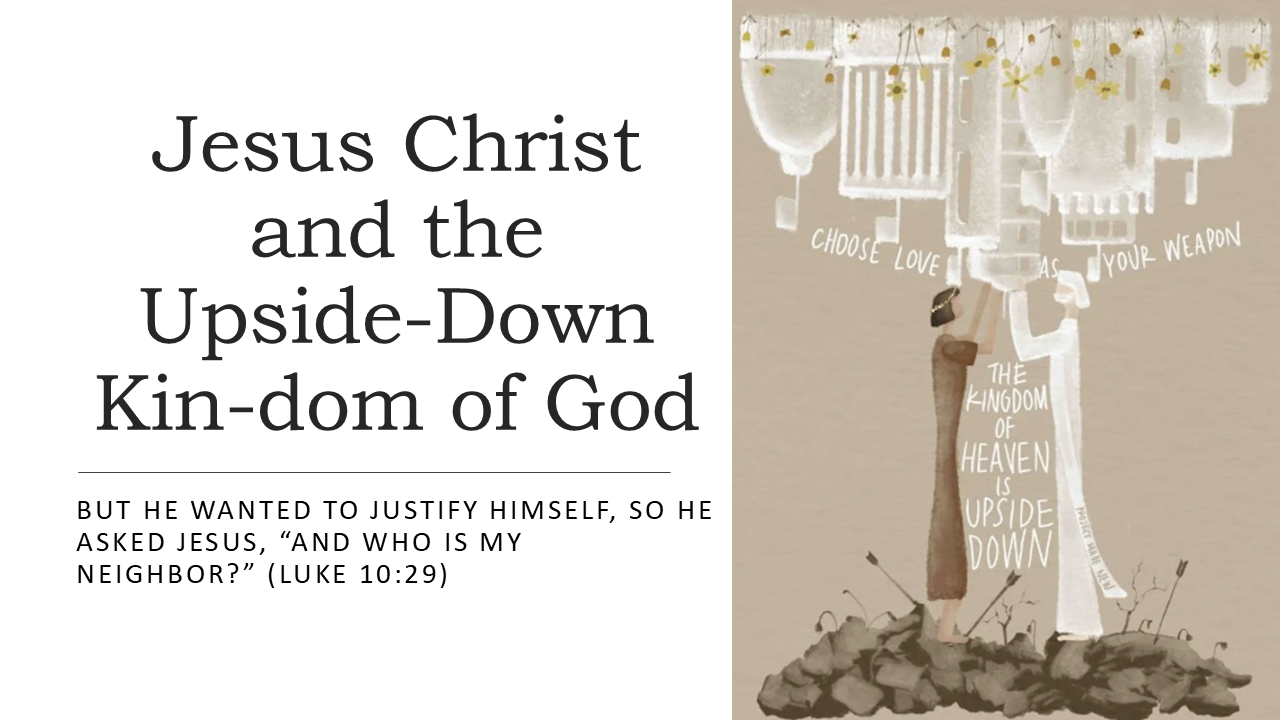
Throughout his ministry Jesus shockingly deemphasizes biological family and ethnic heritage in favor of a wider and more diverse family of God. Jesus is saying that the kingdom of God is not about shared biology or shared ethnicity or shared ancestry. It’s really—not by our own thinking—a kingdom at all. In fact, some modern theologians will remove the G from that word and say that a better phrase is not a kingdom but a kin-dom. Kingdom suggests a vertical hierarchy. Kin-dom suggests a horizontal solidarity. It is a family. And we don’t all look alike.
Members of the kingdom become part of the kin-dom. Those who are on the fringes, out there on the outer circles of loves are brought in close.
It seems to me that the nature of Jesus’s preaching was almost universally about inverting the natural order of love. Love your neighbor, Jesus says, then tells a story about a Samaritan who shows love to an oppressor. Love your enemy, Jesus says, speaking to a people oppressed by Rome. Because
“If you love those who love you, what reward will you get? Are not even the tax collectors doing that?” (Matt. 5:46)
Jesus is saying that it’s easy to love the people here in the middle of the circle. Love those who love you? The worst people you know do that. Rather, the call of God is to love those that are difficult to love. The people who are hard to love are the people you have to work at loving, so my efforts to love them must greater than those whom I love by nature. This is the whole concept of loving one’s enemy.
The story of the early church is one of bringing those on the fringes of the ordo amoris hierarchy into the inner circle of fellowship and love. Let me give you a bird’s eye view of the early church in Acts.
Acts chapter 1: Jesus ascends into heaven and he leaves a mostly uniform but still somewhat diverse group of people. Acts 1:15 says that the believers numbered about 120. All Jews, mostly men, mostly Galilean, mostly been all a part of this Jesus experiment for the past few years. But then, Acts chapter 2.
Peter preaches at Pentecost and a diverse group of Jewish foreigners respond to the Gospel. Acts 2 records that the Holy Spirit comes down in power and when Peter preaches, the people hear him in their own language. It says that there are:
Parthians, Medes and Elamites; residents of Mesopotamia, Judea and Cappadocia, Pontus and Asia, 10 Phrygia and Pamphylia, Egypt and the parts of Libya near Cyrene; visitors from Rome 11 (both Jews and converts to Judaism); Cretans and Arabs
The family of God is widening. Then Acts 3 and 4, Peter and John heal a disabled person—someone prevented from entering the Temple, prevented from fellowship in the community of God—and bring them into God’s family. In Acts chapter 5, it says
more and more men and women believed in the Lord and were added to their number.
In Acts 6, this growth and diversity brings about the first logistical problem in the church.
Hellenistic Jews among them complained against the Hebraic Jews because their widows were being overlooked in the daily distribution of food.
The church leaders realize that they have loved the Hellenistic or Greek Jews less than their own people and they create the office of deacon to ensure that everyone is loved well and part of God’s family. Then Acts chapter 8 and Philip is preaching in Samaria, bringing Samaritans into God’s kingdom. Later in the chapter, he meets a eunuch, an Ethiopian who doesn’t fit traditional gender norms and brings them into God’s kin-dom.
Acts chapter 9, the greatest enemy to the early church, Saul of Tarsus, has this experience on the Damascus Road where he sees Jesus and Saul who would become Paul is moved from the fringes and being an enemy of God into God’s family. Then Acts chapter 10 where a Roman Centurion is added to this menagerie of misfits that now comprise the church.
Everybody on the fringes, everybody on the outside, everybody that our hierarchy of loves says should come at the end, God says bring right into the middle. The kin-dom of God inverts our hierarchy of love and in so doing tears it down. There is no hierarchy to God’s love. Just look at the cross, made available freely for all.
But that can be scary. And in fact that is the pushback that I often receive. That if I widen the way in which I love then I might have to make do with less so that others can have enough. I might open myself up to difficult or dangerous circumstances. JD’s a firefighter, right? That can be a dangerous job. Under this hierarchy of love, he shouldn’t be a firefighter because the potential harm to himself or his family outweighs the potential harm done to community if he isn’t a firefighter. But he chooses to love his community. He puts himself at risk and considers it worth it because of love.
And that’s what I want to end with. Love is patient. Love is kind. It does not envy. It does not boast. It is not proud. But it sure is dangerous. It’s not some hippie-dippie, circle round the campfire and sing kumbaya, type of thing. In fact, this type of love almost ensures that we will face danger. That we will be harmed.
Because love does not dishonor others, because it is not self-seeking, because it is not easily angered, because it keeps no record of wrongs. Because of that love places us in dangerous situations, there will be those who take advantage of that love.
The great theologian C.S. Lewis once wrote:
To love at all is to be vulnerable.
We know that love is going to hurt because when God loved, it took his Son. When Jesus loved, it put him on a cross. We serve a God who died, whatever made you think anything about this love was supposed to be safe? Our love is meant to be an extension and a mirroring of God’s love. It’s not easy. It’s sacrificial.
In the kin-dom of God there is a re-ordering of love. Nobody’s on the fringes. Nobody gets let out. In fact, those who were on the outside get brought into the center. The homeless, the immigrant, the refugee, the poor, the sick, the addicted; any group hated, excluded, left out, ignored, outcast, reviled, erased. Jesus brings them all into the community of God. And when we live that love, we cannot fail.